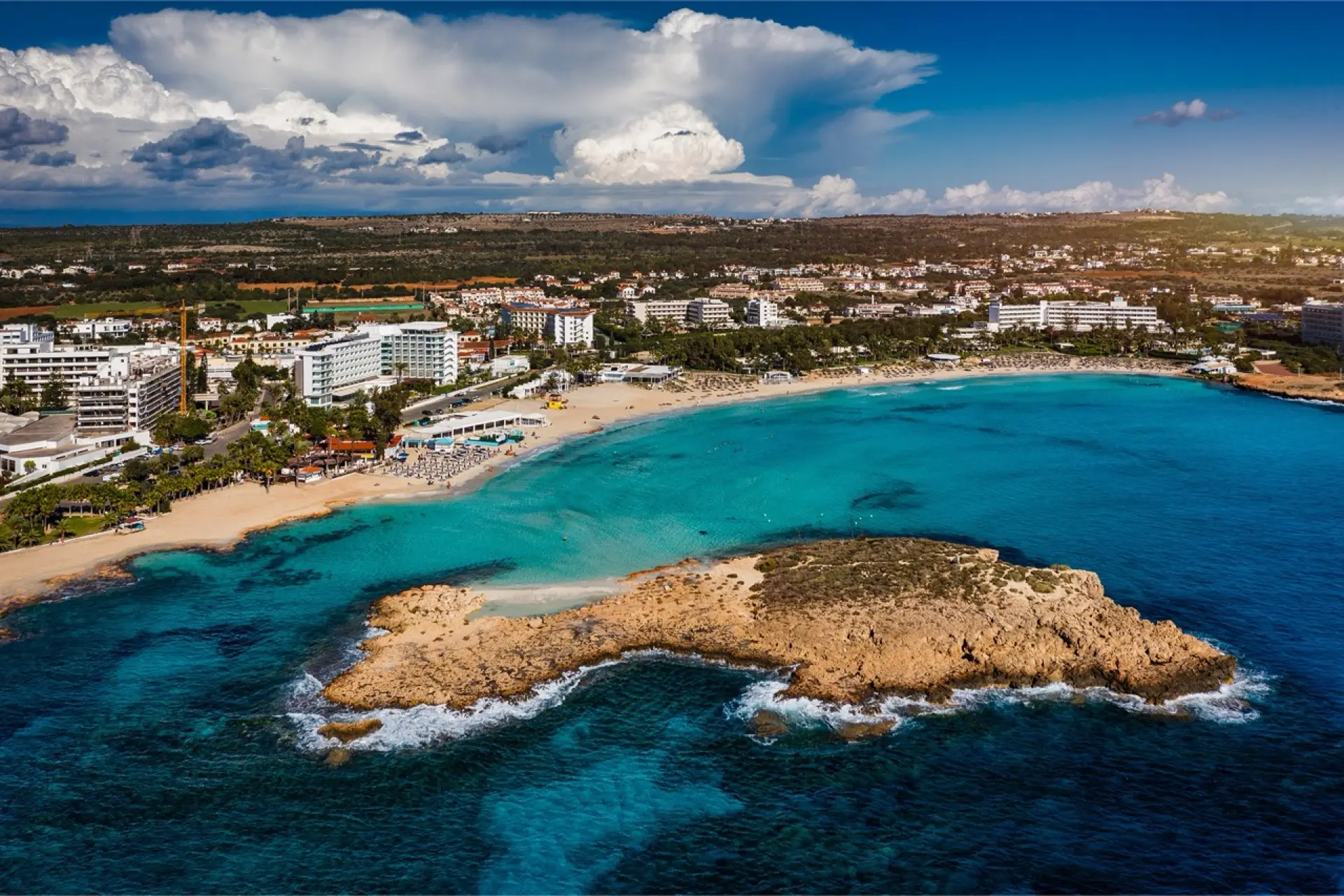
Ayia Napa is easy to reduce to one image: bright water, Nissi Beach, and a very lively summer night. That image is real, but it is incomplete. The town grew from a small agricultural and fishing settlement around its medieval monastery into one of Cyprus’s best-known coastal resorts, and today its appeal stretches from nightlife and beach holidays to family stays, second homes, luxury villas, nature tourism, and high-end marina property. Archaeological evidence around Nissi and Makronissos also pushes the area’s human story back thousands of years.
For buyers, the most useful way to understand Ayia Napa is not as one uniform market but as a string of distinct coastal micro-markets. The town center is the most urban and nightlife-oriented. Nissi and the western beach corridor combine intense visitor demand with newer apartments and villas. Makronissos and Landa feel more resort-like and spacious. The harbor/Glyki Nero side offers walkability with easier access to the eastern coastline and Cape Greco. Ayia Thekla and the marina form the low-density, villa-heavy, increasingly premium western end. The municipality's and Deputy Ministry of Tourism's maps and beach descriptions make this west-to-east pattern particularly clear.
Ayia Napa sits on the southeastern coast of Cyprus, where a compact town center opens onto a remarkably varied sequence of sandy bays, coves, a working harbor, a modern marina and the rocky landscapes leading toward Cape Greco. It is one of Cyprus's most developed tourism destinations, yet it remains small enough that your choice of neighborhood can noticeably change the feel of everyday life.
The western side is dominated by Nissi Avenue and the major resort beaches. The historic and commercial center sits around the monastery and central square. The harbor and long Pantachou/Glyki Nero shoreline stretch eastward, while the landscape becomes progressively greener and less urban toward Cape Greco. To the west, Ayia Thekla and Ayia Napa Marina create a different environment again, with more detached villas and premium waterfront development.
That geography explains much of Ayia Napa's appeal. You can choose busy, walkable resort life, a beachfront apartment, a villa farther from the center, or something closer to nature without leaving the same local market.
Families often find more to like here than the town's nightlife reputation suggests. Makronissos, Landa and parts of Ayia Thekla offer a noticeably calmer setting than the central entertainment zone, while shallow sandy beaches, resort facilities and coastal paths provide an easy outdoor lifestyle. The municipality lists a public/community kindergarten, the town has the Antonis Tsokkos primary school, and a new kindergarten and nursery project is part of the municipality's current investment program.
The main caveat is schooling depth. Families needing a particular international curriculum or extensive secondary-school choice should map the school commute before choosing a home rather than assuming a resort town has the same educational ecosystem as Cyprus's larger cities.
Ayia Napa can work well for expats who prioritize the coast over big-city amenities. English is widely usable in the visitor economy, and the strong hospitality sector makes daily life relatively straightforward for international residents during the tourism season. The large tourism accommodation base and officially registered restaurants and entertainment businesses illustrate how internationally oriented the local economy is.
Winter is the important reality check. The town does not simply switch off, but the contrast between high season and the quieter months is meaningful. AirDNA's seasonality score of 44/100 for 2026 is a useful quantitative sign of that peak-and-trough pattern.
Hospitality, food and beverage, excursions, property services, leisure, marine activities and tourism-facing retail are natural sectors here. Ayia Napa Marina has broadened that mix toward yachting, waterfront dining, events and higher-end residential services.
The trade-off is that a tourism-led location rewards businesses that understand seasonal cash flow.
Remote workers who care more about sea access than a dense coworking ecosystem can find Ayia Napa attractive, particularly outside the busiest summer weeks. Central apartments offer walkability, while Nissi and the eastern side offer a more beach-oriented routine.
For someone who needs frequent in-person meetings, a major corporate ecosystem or a large professional-services cluster, Ayia Napa is a lifestyle choice rather than Cyprus's obvious business-center choice.
Investors have several quite different strategies available: conventional apartments, holiday apartments close to the beaches, villas aimed at group stays, and high-value waterfront property.
Tourism demand is substantial. AirDNA counted 1,052 active short-term rentals in August 2026, with 97.2% offered as entire homes. By its October update, 1,029 active properties were generating 61% average occupancy across the trailing market, although supply had declined materially year on year.
The opportunity comes with two cautions. First, seasonality remains strong. Second, Cyprus requires self-service accommodation such as villas, houses and apartments to be registered for lawful operation in the sharing-economy accommodation system.
Ayia Napa's history begins long before package tourism. The municipality records prehistoric evidence in the Nissi Beach and Tigani areas, followed by Archaic and Classical-period remains around Makronissos. In the Hellenistic and Roman periods, the coast included sanctuaries, burials, agricultural activity and water infrastructure.
Makronissos remains one of the clearest places to see that earlier landscape. The Deputy Ministry of Tourism describes a complex of 19 rock-cut tombs together with a sanctuary and an ancient quarry, with use extending through the Hellenistic and Roman eras.
A later settlement developed around the monastery. According to the municipality's historical account, the monastery dates to the Lusignan period, with construction in the 14th century, and a permanent community eventually formed around it. The settlement remained associated with farming and fishing before expanding dramatically during the second half of the 20th century as tourism transformed the coast.
timeline
    title Ayia Napa development at a glance
    Prehistoric era : Early settlement evidence around Nissi and Tigani
    Hellenistic & Roman eras : Makronissos burials, sanctuary and agricultural activity
    Medieval period : Monastery develops under Lusignan rule
    Late twentieth century : Farming and fishing settlement grows into a major resort town
    2005 : Thalassa Municipal Museum opens
    2020s : Marina and premium waterfront development broaden the destination
The timeline is synthesized from the municipality's historical record, the Deputy Ministry of Tourism's Makronissos material, the municipality's record of the Thalassa Museum opening in August 2005, and the current Ayia Napa Marina development.
Ayia Napa's geography is unusually helpful for understanding the property market. The town runs along a low Mediterranean coast with a central urban core, a chain of sandy western beaches, a harbor and long eastern beachfront, and the rocky headlands and protected landscape toward Cape Greco.
Rather than thinking only in terms of distance from “the center,” buyers should ask three questions: how close do I want to be to the beach, how close do I want to be to nightlife, and how much do I value easy access to open coastal landscape?
The simplest mental map starts with Nissi Avenue. It runs through the western resort belt, connecting the center with Vathia Gonia, Nissi, Landa and Makronissos. The central streets rise toward the monastery and entertainment area. South and southeast, the town drops toward the harbor, Pantachou and Glyki Nero. West beyond the main resort strip lies Ayia Thekla and the marina.
This layout produces very different living environments within a short distance. A centrally located apartment may put restaurants and nightlife outside your door. A home around Makronissos feels more like a beach resort. A villa around Ayia Thekla can feel suburban and low-density.
Ayia Napa has the hot, dry summer and mild-winter rhythm associated with Cyprus's southeastern coast. For beach users, the municipality's sea-temperature guidance is especially useful: published monthly averages/ranges run from roughly 17°C in January and February to around 27°C in August.
For residents, climate affects the property decision as well as the lifestyle. Orientation, shading, efficient air-conditioning, insulation and outdoor space are worth checking carefully, particularly in newer villas and glass-heavy luxury developments.
Ayia Napa has two personalities, and trying to pretend otherwise is not very useful.
In summer, the center, Nissi corridor and main beaches can be intensely energetic. Restaurants, beach venues, clubs, boat trips and water sports create a classic resort atmosphere. The municipality itself describes a broad nightlife mix of restaurants, pubs, tavernas, cafés and clubs.
Move away from those concentrations, however, and the experience changes quickly. Morning swims, coastal walks, café lunches, cycling toward Cape Greco and quiet villa neighborhoods are just as much part of local life.
That contrast is a strength for buyers who choose carefully. It can be a problem for someone who buys based on a winter viewing and discovers in July that the street has a completely different personality.
Most everyday services are concentrated along the central commercial streets and Nissi Avenue. The visitor economy supports supermarkets, bakeries, pharmacies, banks, restaurants and other services across the main resort zone. RERA's centrally located Ayia Napa apartment descriptions, for example, repeatedly emphasize walking access to restaurants, banking, bakeries, shops and medical services.
The difference between a holiday and living here becomes most apparent in winter. Buyers planning permanent residence should revisit their preferred area outside peak season, check which nearby services remain open, and assess whether they are comfortable relying more heavily on a car.
Local public transport is operated by OSEA, which runs routes throughout the government-controlled Famagusta district as well as connections toward Larnaca. InterCity Buses also publishes routes linking Ayia Napa with other major Cyprus destinations.
Buses are genuinely useful along the tourism corridor, particularly for beaches and central destinations. A car becomes more valuable if you live in Ayia Thekla, plan frequent shopping outside the resort core, or want to explore less central parts of the coast.
For visitors without a car, the town's relatively linear coastal layout helps. For permanent residents, parking provision should be treated as a real property feature rather than an afterthought.
The names below are practical property-market areas rather than rigid official neighborhood boundaries.
Best suited to: younger residents, hospitality workers, investors and buyers who value walkability.
Atmosphere: urban by Ayia Napa standards, busiest around the monastery, central square and entertainment streets.
Property types: mostly apartments, older low-rise buildings, renovated units, small modern developments and occasional houses.
Advantages: easy access to restaurants, services and nightlife; lower entry prices are sometimes available than immediately beside the best-known beaches. Entry-level one-bedroom Ayia Napa apartments at about €130,000–€180,000, although newer central
Points to consider: summer noise, parking and street activity vary dramatically block by block.
Best suited to: holiday-home buyers, short-term rental investors and owners who want a famous beach within walking distance.
Atmosphere: resort-driven, busy in summer and strongly international.
Property types: apartments, penthouses, holiday complexes and modern villas.
Advantages: Nissi is one of Ayia Napa's signature beaches, about 3 km from the town center according to municipal information, with sheltered water and extensive water-sports activity.
Property here generally carries a beach-proximity premium. Current RERA examples around Ayia Napa include modern apartments from the mid-€300,000s into the €600,000s, while Cyprus Sotheby's 2026 inventory has shown new villas in the wider Nissi/Ayia Napa area from roughly €600,000 upward.
Points to consider: tourist footfall, traffic and strong seasonal demand can be either an advantage or a disadvantage depending on whether you are buying to live or let.
Best suited to: families, beach-focused second-home buyers and investors seeking a calmer resort environment.
Atmosphere: relaxed compared with the center, with larger hotel grounds, sandy bays and more open space.
Property types: villas, holiday homes, apartments and resort-style complexes.
Advantages: Makronissos is a cluster of three bays roughly 5 km from central Ayia Napa, while nearby Landa is linked into the coastal pedestrian network. The Makronissos archaeological site adds something unusual: a major beach and an ancient landscape in the same small area.
For conventional three- and four-bedroom Ayia Napa villas, 2026 asking data suggest roughly €450,000–€1.1 million covers much of the non-ultra-luxury market, while frontline and exceptional properties can move well above that range.
Points to consider: it is less convenient than the center for people who want everything outside their front door.
Best suited to: couples, lifestyle buyers and investors who want both town access and a more scenic beachfront setting.
Atmosphere: lively around the harbor, progressively calmer toward the eastern end.
Property types: apartments, hotel/resort stock, townhouses and a limited number of high-end houses.
Advantages: Ayia Napa's renovated harbor combines fishing boats with restaurants, cafés, walking areas and an outdoor event space. Pantachou extends for more than a kilometer east of the harbor, while Glyki Nero continues toward the sea-cave coastline.
This is a useful compromise area. You can walk toward the town center while being better positioned for the eastern coast and Cape Greco.
Points to consider: properties advertised as “Glyki Nero,” “harbor” or “sea view” can differ considerably in elevation and true walking distance to the water, so inspect the route rather than relying on listing language.
Best suited to: families, second-home buyers, villa investors and premium waterfront buyers.
Atmosphere: low-density and residential away from the marina itself, with a distinctly more polished waterfront environment around the marina.
Property types: detached villas, pool villas, seafront homes and premium marina residences.
Advantages: Ayia Thekla beach lies about 8 km west of central Ayia Napa, and the area's detached-housing stock is much more prominent than in the center. Ayia Napa Marina has added a purpose-built yachting, residential and leisure destination to this end of the coastline.
A useful September 2026 snapshot from Offer.com.cy showed around 27 Ayia Thekla houses/villas for sale with a median asking price of about €530,000 and median asking rate around €3,851/m². The sample ranged from conventional three-bedroom villas in the €400,000s to seafront luxury homes well above €1 million. Treat those numbers as portal inventory, not official valuations.
Points to consider: a car is more useful, and “marina,” “Ayia Thekla” and frontline villas belong to very different price brackets even though they are geographically close.
Ayia Napa is not one property market. At least four segments overlap:
ordinary resale apartments; newer beach-oriented apartments and penthouses; detached holiday villas; and a small luxury waterfront/marina segment.
As of 2026, marketplace asking-price guidance gives a broad town-wide picture: roughly €130,000–€180,000 for entry one-bedroom apartments, €180,000–€260,000 for entry two-bedroom units, €260,000–€380,000 for entry three-bedroom apartments or penthouses, and about €450,000–€650,000 at the lower end of the three-to-four-bedroom villa market. Premium locations quickly exceed those levels.
Live RERA evidence shows why buyers should not use one town-wide average. A two-bedroom 142 m² apartment has recently been marketed at €516,000, with nearby active one- and two-bedroom examples around €350,000 and €625,000. A five-bedroom 189 m² detached home has been marketed at €735,000, while nearby active villa examples have ranged from around €400,000 to €1.35 million. RERA has also carried a 408 m² new-build beachfront villa at €2.88 million.
The broader trend remained upward in Q2 2026. RICS/KPMG reported national year-on-year price growth of 5.42% for apartments, 4.04% for houses, 5.18% for holiday apartments and 3.01% for holiday houses. Famagusta holiday apartments rose about 0.63% quarter on quarter and holiday houses about 1.39% in the index.
Rental yields require more care.
RICS/KPMG's Q2 2026 national investment-yield indicators were approximately 5.82% for holiday apartments and 2.85% for holiday houses. These are not Ayia Napa-specific yields.
Long-term yields around 4%–5%, seasonal holiday-let yields around 6.5%–9.5%, and realistic net short-term returns around 4.5%–6.5% after operating costs. Those figures come from a property marketplace rather than an independent valuation index, so they are better treated as an underwriting starting point than a promised return.
AirDNA offers a useful reality check. Its September 2026 data showed 61% annual occupancy and $235 ADR, but also a strong seasonal swing and declining active supply. A prospective landlord should therefore model income month by month rather than multiplying an August nightly rate by 365.
For short-term rental supply, AirDNA's August 2026 dataset shows how residential the market really is: 97.2% of active listings were entire homes rather than private rooms.
pie showData
    title Ayia Napa short-term rental property type distribution, Aug. 2026
    "Entire home" : 97.2
    "Private room" : 2.8
The same dataset shows one-bedroom homes at 41.4% of active supply, two-bedroom homes at 20.5%, three-bedroom homes at 16.2%, four-bedroom homes at 9.8%, and five-bedroom-plus homes at 12.1%.
Ayia Napa's cost profile depends heavily on lifestyle and location. A resident cooking at home and living away from the major tourist streets will experience the town very differently from someone dining out daily beside a flagship beach.
Housing is the biggest variable. Older central apartments can occupy a completely different price bracket from new beach developments, while detached villas bring pool maintenance, cooling, garden care and typically greater transport costs.
For buyers, the practical budget should include more than the mortgage or purchase price: communal charges for apartments, pool and landscape maintenance for villas, insurance, air-conditioning and electricity, property-management costs if the home is rented, and periods with limited rental income.
Tourism remains the central economic engine. The Deputy Ministry of Tourism's 2026 accommodation register shows a large concentration of hotels throughout Ayia Napa, while official lists of restaurants and entertainment establishments illustrate the depth of the hospitality ecosystem.
That produces jobs in hotels, restaurants, entertainment, excursions, property management and tourism services. The marina adds yachting and marine services, events, retail and premium hospitality to the mix.
The downside is cyclicality. Anyone moving here for employment should distinguish between a business that trades twelve months a year and one whose staffing needs are concentrated in the tourism season.
Ayia Napa has its own public primary school, officially named the Agia Napa Primary School “Antonis Tsokkos.” The municipality also operates or supports early-years provision and lists a new public/community kindergarten and nursery among its current projects.
The municipal library, founded in 1988, also maintains lending collections and historical/folklore archives.
For buyers with school-age children, the practical issue is not simply whether a school exists. Check language, curriculum, secondary-school plans, transport and after-school requirements before fixing a property search radius.
Ayia Napa has local medical and pharmacy services, but the principal public hospital for the district is Famagusta General Hospital in Paralimni. The State Health Services Organisation lists the hospital at Ippokratous, postcode 5310, with emergency and specialist departments, while the associated Famagusta health center provides primary-care services.
For medical emergencies, SHSO lists 112 as the ambulance/emergency number.
For permanent residents, proximity to a pharmacy or GP is worth checking separately from proximity to the beach, particularly if the property is toward the outer western or eastern edges of the resort.
Beaches are the strongest part of Ayia Napa's case, and they are not interchangeable.
Nissi Beach is the headline name, roughly 3 km from town, with a sheltered sandy bay, shallow-looking turquoise water around its small islet and a strong water-sports and beach-venue scene.
Makronissos is a cluster of three bays around 5 km from the center. It is sheltered and combines swimming with direct access to the archaeological tomb complex.
Landa Beach, between Nissi and Makronissos, is linked into the pedestrian coastal path and has nearby picnic facilities.
Vathia Gonia is a compact sheltered bay between Nissi and central Ayia Napa, with a pedestrian connection running east toward the harbor and west toward Makronissos.
Pantachou begins around the harbor and runs for more than a kilometer, backed by restaurants and visitor facilities. Glyki Nero continues eastward toward the sea-cave coast.
Ammos Kambouri is a smaller cove on the way toward Cape Greco, while Kermia/Limnara occupies the quieter eastern fringe.
Agia Thekla Beach, around 8 km west of the center, has a much lower-density setting and a small offshore islet.
The harbor is one of the nicest transitions between “working town” and “holiday town.” The renovated waterfront includes fishing boats, excursion craft, restaurants, cafés, pedestrian space, fountains and an outdoor theater/event area.
The coastal pedestrian connections extending west and east are especially valuable for residents because they turn the shoreline into everyday infrastructure rather than simply a place for a beach day.
The center gathers restaurants, bars, shops and entertainment around one of Ayia Napa's oldest landmarks. In high summer it can be intensely busy. In quieter months the same streets feel much more like a small Cypriot town.
That seasonal change is part of Ayia Napa's character rather than a minor detail.
The monastery is the historical anchor of the town and the reason the settlement developed where it did. Municipal history traces it to the Lusignan period, with later settlement growing around the religious complex.
For a modern resort known internationally for beaches and clubs, having a medieval landmark at its center gives Ayia Napa a stronger sense of place than its party-town stereotype suggests.
Ayia Napa Marina represents the clearest shift toward the premium end of the destination. Located on Ayia Thekla Avenue, it combines yacht infrastructure, residential property, dining, commercial activity and events.
For property buyers, it matters even if you never intend to own a marina residence: it has created a luxury benchmark on a coastline that was previously dominated by conventional holiday apartments, villas and hotels.
Makronissos Tombs are the most immediately accessible archaeological attraction, with 19 rock-cut tombs, a sanctuary and an ancient quarry.
Cape Greco is the major natural counterweight to the resort. The municipality promotes the cape for hiking and cycling as well as its flora, fauna and rocky coastal scenery. Sea caves, cliff viewpoints and clear-water coves create a landscape that feels very different from the built-up Nissi corridor.
Thalassa Municipal Museum, opened in August 2005, provides the cultural bridge between those themes, focusing on the sea and Cyprus's maritime relationship with it.
Ayia Napa's cultural identity mixes Orthodox and medieval heritage, fishing traditions and a newer festival culture.
The monastery remains central, while the Thalassa Museum, Makronissos archaeology and municipal cultural programming broaden the town beyond beach tourism. In October 2026, for example, the municipality is hosting the 21st Ayia Napa Medieval Festival in the central square.
That matters for residents because cultural programming increasingly gives the center reasons to be used outside the classic beach-and-nightclub routine.
It is better not to make sweeping claims about Ayia Napa's crime level without comparable police statistics.
Practically, most visitor risks are the familiar ones of a busy Mediterranean resort: road awareness, alcohol, protecting valuables, heat and sun exposure, and respecting sea conditions. For genuine medical emergencies, Cyprus's emergency number is 112.
Families and buyers concerned about summer noise should think about “safety and comfort” at street level too. Visit a prospective property late in the evening during peak season, not only at 11 a.m. in February.
Ayia Napa offers unusually easy access to high-quality sandy beaches, a walkable central resort zone, a strong restaurant and leisure scene, Cape Greco on the doorstep, and a property market ranging from relatively attainable apartments to high-end coastal villas.
The compact scale is another advantage. Choosing a quieter neighborhood does not necessarily mean giving up the center altogether.
For investors, the tourism engine is substantial rather than hypothetical. AirDNA was tracking more than 1,000 active short-term rentals in 2026, while official tourism registers show a deep hotel and hospitality base.
Seasonality is the biggest caveat. AirDNA's seasonality score remains relatively low, and anyone underwriting a holiday rental should expect a meaningful difference between peak and off-season months.
The next issue is neighborhood variation. Central nightlife can be an asset for one buyer and a deal-breaker for another.
Finally, premium beach and marina property has pushed parts of Ayia Napa far beyond the old “cheap holiday apartment” image. Live RERA and Ayia Thekla listing data show asking prices from the mid-six figures into multimillion-euro territory.
Choose Ayia Napa when beaches, outdoor living, tourism demand and a resort atmosphere are priorities.
Larnaca generally makes more sense when airport access, a more conventional year-round urban routine and a broader service base matter more. Limassol is the stronger fit for people whose first priority is a large corporate and professional economy, but its property market is generally positioned at a different price level; the RERA Limassol guide itself emphasizes the city's business, technology and employment role.
Paphos is another logical comparison for resort-property buyers, particularly those who prefer western Cyprus, a larger spread of residential communities and an archaeology-led visitor identity.
Ayia Napa's comparative advantage is simpler: for a buyer who genuinely wants to organize life around southeastern Cyprus's beaches, very few alternatives deliver that experience as directly.
No. The central nightlife district is real, but Makronissos, Landa, Ayia Thekla, the marina side and parts of the eastern coast have very different atmospheres. Official tourism and municipal material presents Ayia Napa as a combination of beaches, nature, archaeology, museums, sports and nightlife rather than nightlife alone.
It can be, particularly outside the central nightlife streets. The town has primary and early-years education, family-oriented resort infrastructure and numerous sheltered beaches. Families needing specialist or international schooling should investigate the commute before purchasing.
The range is unusually wide. Marketplace guidance starts around €130,000–€180,000 for some entry-level one-bedroom apartments, but newer and beach-oriented apartments commonly move into the €300,000–€600,000-plus range. Typical villas can begin around €400,000–€500,000, while seafront and luxury homes can exceed €1 million and reach several million euros.
There is no single defensible Ayia Napa yield. Long-term yields of roughly 4%–5% and seasonal holiday-let yields around 6.5%–9.5% in April 2026, while RICS/KPMG's Q2 2026 national benchmark was 5.82% for holiday apartments and 2.85% for holiday houses. The different methodologies are exactly why a buyer should model the specific property rather than quote a town average.
Yes, but qualifying self-service accommodation must be registered through the Cyprus government's official system and receive the appropriate registration identification.
For maximum exposure to tourist demand, Nissi and the central/western resort corridor are obvious candidates. Ayia Thekla and the marina are more villa- and premium-property oriented. The harbor/Glyki Nero area offers a useful middle ground between walkability and coastal lifestyle. The best answer depends on whether the investment model is short-term rent, long-term rent, capital preservation or personal use.
Makronissos/Landa and the lower-density parts of Ayia Thekla are stronger starting points than the entertainment center. The precise street still matters, particularly in summer.
Not necessarily for a holiday in the center or along the main bus corridor. For year-round living, a car becomes considerably more useful in lower-density western areas and for regular trips outside the resort. OSEA operates the local district network and connections toward Larnaca.
Ayia Napa is still the place people imagine when they think of turquoise water, beach bars and summer nights. It just is not only that place anymore.
Spend a few days moving from the monastery to the harbor, from Nissi to Makronissos, west toward Ayia Thekla and then out toward Cape Greco, and the town starts to make much more sense. The nightlife becomes one layer rather than the whole story. Archaeology, nature, residential neighborhoods, family resorts and a rapidly more sophisticated waterfront market sit alongside it.
For property buyers, that variety is both Ayia Napa's opportunity and its trap. Two homes only a few kilometers apart can serve completely different lifestyles and rental markets. Asking prices range from comparatively affordable apartments to multimillion-euro waterfront villas, while strong tourism demand is counterbalanced by genuine seasonality.
The best buying strategy here is therefore wonderfully unglamorous: pick the lifestyle first, the micro-location second, and the property third. The sea will still be there when the spreadsheet is finished.

Already have a place in mind? Take the next step and explore homes available across Cyprus.
Browse apartments, houses and new developments, explore properties on the map and compare your favourites to find the right fit.
