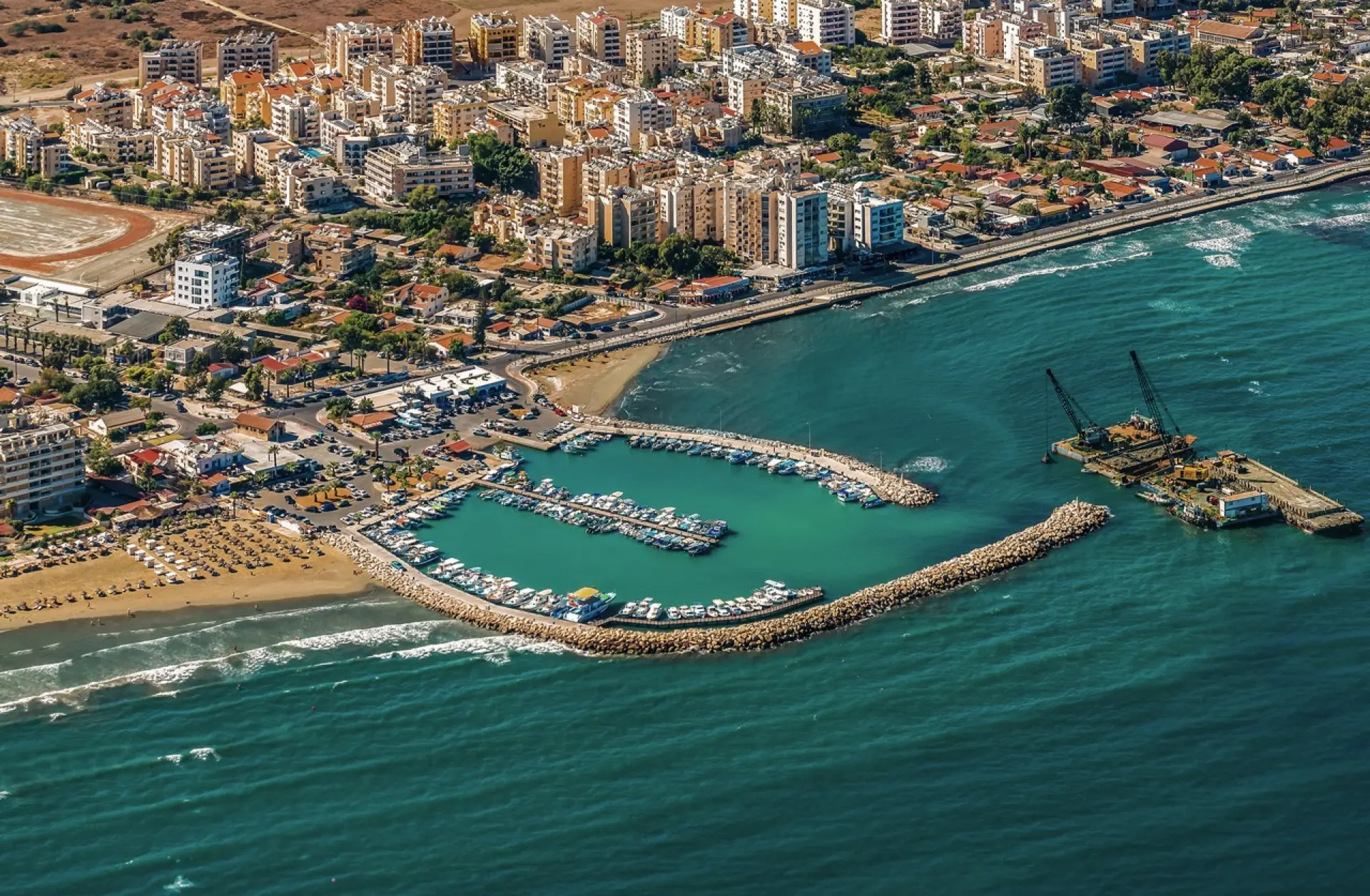
Larnaca is one of those cities that makes more sense after you spend a little time there. At first glance, it looks like a relaxed Mediterranean beach town. Then you notice that the historic center, ordinary residential streets, seafront cafés, airport, Salt Lake and some of Cyprus's most important religious and archaeological sites are all packed into a surprisingly compact area. Official tourism material describes Larnaca as both compact and unusually authentic, with very little separation between the resort and the everyday city.
For people considering a move to Cyprus, that is Larnaca's real appeal. You can live by the sea without quite the scale, intensity or property costs associated with Limassol, while having the country's principal international air gateway practically on your doorstep. The trade-off is a smaller corporate job market and greater car dependency once you leave the central waterfront and established urban neighborhoods. RERA itself describes Larnaca as an alternative for people seeking seaside life, more affordable housing than Limassol and convenient airport access.
The property market deserves a little more attention than the old “cheap coastal city” stereotype suggests. In Q2 2026, RICS/KPMG reported Larnaca as the strongest district for apartment price growth, with houses, offices and warehouses also showing notable momentum. Meanwhile, official DLS data recorded 2,876 sales cases and roughly €480.1 million in declared transaction value in Larnaca District during January–September 2026. In other words, Larnaca can still offer a different price level from Limassol, but it is no longer a market I would describe casually as undiscovered.
Location | Southeast coast of Cyprus; capital of Larnaca District. |
Population | Larnaca District: 155,765, final 2021 census. |
Overall feel | Compact, coastal, historic and noticeably more relaxed than Cyprus's larger business centers. The tourism authority emphasizes the overlap between resort life and the everyday town. |
Best for | Beach-city living, families, frequent flyers, remote workers and buyers who want a smaller coastal city without giving up everyday services. |
Typical housing | Apartments dominate many central and coastal locations; houses and lower-density developments become more common farther inland and toward the outer urban area. Current market momentum is strongest in residential property. |
Living costs | Usually positioned below Limassol for housing, although costs vary sharply by location and new-build specification. RERA explicitly identifies Larnaca as the more affordable coastal alternative to Limassol. |
Car need | Optional for some central lifestyles; increasingly useful for schools, outer residential areas and exploring the district. Cyprus Public Transport operates Larnaca urban and rural services. |
Climate | Mediterranean, with long dry summers and mild winters. Cyprus's official tourism portal describes the dry summer period as generally running from mid-May to mid-October. |
Larnaca can work particularly well for families who want the sea nearby but do not need the scale of Limassol. The center is compact, residential neighborhoods sit only a short distance inland, and the wider district gives you beaches, villages, nature and family day trips without turning every weekend into a long journey. Families should still choose the neighborhood around the school rather than the other way around, especially when private education, school transport or a specific curriculum is important. Cyprus's Ministry of Education is the authoritative starting point for checking the current school system and registered institutions.
Larnaca is an easy city to understand geographically. Finikoudes gives you an obvious center of gravity, the old streets sit immediately behind it, Piale Pasha leads south toward Mackenzie, and the airport is close enough that international travel becomes part of ordinary life rather than a cross-island expedition. That practical simplicity is one reason Larnaca works well for newcomers.
The opportunity is different from Limassol. Larnaca is not Cyprus's largest corporate headquarters market, but tourism, hospitality, aviation, professional services, property and construction create a broad base for smaller businesses. Airport expansion also matters: Hermes Airports' Phase II plan includes roughly 20,000 square meters of additional works at Larnaka Airport and is intended to lift terminal capacity to 12.4 million passengers per year on completion.
For remote workers, the proposition is more about lifestyle and connectivity than a giant local technology ecosystem. You have a compact city, year-round cafés and services, the coast for a pre-work walk, and unusually convenient international flights. Larnaka and Pafos airports were jointly reported by Hermes as leading European airports for growth in direct air connectivity in 2025, with an 18% increase compared with 2024.
Larnaca is worth looking at, but with the right expectations. RICS/KPMG's Q2 2026 results said apartments were the strongest-performing asset class across Cyprus and that Larnaca led the major districts; housing gains were also particularly strong in Larnaca and Paphos. That is evidence of momentum, not a guarantee of future returns. Buyers still need to evaluate individual location, title status, building condition, rental rules, service charges and realistic tenant demand.
Larnaca wears its history fairly casually. You can go out for coffee, turn a corner and suddenly find yourself beside a church, mosque, archaeological remains or an old street that reminds you how many versions of the city have existed before the present one.
Cyprus's official tourism portal describes Larnaca as the island's longest continually inhabited region and traces its story back around 4,000 years. Modern Larnaca developed around ancient Kition, and the city's archaeological identity sits alongside Byzantine, medieval, Ottoman and later layers rather than being confined to a single museum district.
The religious history is just as striking. Agios Lazaros is one of the city's defining landmarks, while Hala Sultan Tekke stands on the western shore of the Salt Lake. The present Tekke complex was constructed in stages beginning in 1760 and completed in 1817, according to the official Cyprus tourism portal, and remains an active religious site.
This is one of the things I like about Larnaca: the history is not arranged at a polite distance from daily life. It sits right inside it. A normal walk from the shopping streets toward the sea can take you through several completely different historical layers within minutes.
Larnaca sits on Cyprus's southeast coast, but “Larnaca” can mean several different things depending on the conversation: the historic city, the current municipality, the broader urban area or the entire district. That distinction matters when you are comparing property or deciding how far you actually want to live from the center.
Following Cyprus's local-government restructuring, the Municipality of Larnaca comprises the municipal districts of Larnaca, Livadia and Voroklini. The wider urban area also meets separate neighboring municipalities such as Aradippou, while Larnaca District extends much farther inland into rural and hilly territory. District-level services were reorganized from July 1, 2024, when the new District Local Government Organizations began operating with responsibilities including development licensing, water, sewage and stormwater drainage, and solid waste.
And the district is much more than beaches. Official tourism material follows Larnaca inland toward the Troodos foothills and villages including Lefkara, Kato Drys, Vavla and Odou, with archaeological sites such as Choirokoitia and Kalavasos Tenta forming part of the region's cultural landscape.
In practical terms, I would think of Larnaca in several broad zones.
The historic center and Finikoudes waterfront form the most walkable part of the city. This is where the promenade, beach, shopping streets, cafés and Agios Lazaros sit close together. Official tourism material makes exactly this connection, describing Finikoudes, the parallel shopping center and the cathedral area as part of one compact urban experience.
To the south, the city becomes more maritime. Piale Pasha passes older neighborhoods and traditional fish taverns before the coastline continues toward Mackenzie. This side of Larnaca has more of that lovely “I was just going for a walk and somehow ended up staying for dinner” quality.
Moving inland, areas such as Faneromeni and Drosia are more residential and less shaped by visitor traffic. To the north and northeast, the urban area continues toward Livadia and Voroklini. Voroklini is around eight kilometers northeast of central Larnaca and sits on slightly raised ground; the municipality notes direct connections toward the Larnaca–Famagusta highway and neighboring Livadia.
Larnaca has the classic coastal Cyprus climate: a long, dry and sunny summer followed by a mild winter, with short transitional spring and autumn seasons. Cyprus's official tourism authority defines the long dry period broadly as mid-May to mid-October and notes that sea breezes moderate conditions along the coast.
The sea remains a surprisingly big part of life beyond peak summer. Official tourism data put open-sea temperatures above 22°C from June through November, reaching around 27°C in August. September and October can therefore feel much more like extended summer than autumn to people arriving from northern Europe.
July and August can still be very hot, so air-conditioning, insulation, orientation and external shading deserve attention when viewing property. A beautiful west-facing apartment can become a very different proposition at four o'clock on an August afternoon.
The best official description of Larnaca may also be the simplest: there is very little separation between “resort” and “town.” Tourists drink coffee beside residents going to work; apartment buildings sit behind beach hotels; historic churches and ordinary shops occupy the same streets.
That makes the city feel less staged than some purpose-built holiday areas. In the morning Finikoudes is a jogging-and-coffee promenade. A few streets back, the center becomes more workaday. Toward Piale Pasha, the pace changes again and the fish taverns take over. In winter, you can add flamingos on the Salt Lake to the routine. The tourism authority specifically highlights the winter flamingo season as one of the district's signature sights.
For somebody living centrally, the city's scale is a genuine advantage. Beach, cafés, restaurants, shops and many everyday services can fit into a fairly small radius. That compactness is one of the characteristics repeatedly emphasized by Cyprus's tourism authorities.
Larnaca becomes more car-oriented as soon as your routine involves outer neighborhoods, a school in another part of the urban area or regular trips into the district. That is an important distinction for property buyers. “Ten minutes from the center” may sound trivial on a listing, but it changes the kind of daily life you are buying.
Buses are Larnaca's principal form of scheduled urban public transport, with Cyprus Public Transport operating both Larnaca urban and rural services and providing real-time information through its digital services.
The airport is the city's outstanding transport advantage. Larnaka International Airport is operated by Hermes Airports, and its planned Phase II expansion includes new arrival and departure gates, baggage facilities, passport-control and security areas, commercial space and additional aircraft parking. Hermes said in March 2025 that the Larnaka works were expected to take 30 months, with annual airport capacity projected to reach 12.4 million passengers after completion.
Inside the historic center and along the waterfront, walking can be genuinely practical. For district villages, dispersed suburbs, school runs and regular cross-city travel, a car remains considerably more convenient.
Larnaca neighborhood names are useful for orientation, but buyers should not assume that every informal neighborhood label corresponds neatly to an administrative boundary. Since the 2024 local-government changes, it is especially useful to distinguish the Municipality of Larnaca and its Livadia and Voroklini municipal quarters from adjacent municipalities elsewhere in the urban area.
Best fit: people who value walkability, history and being right inside the city.
Feel: traditional streets mixed with cafés, shops, small hotels and everyday businesses. Agios Lazaros is the obvious landmark, with Finikoudes only a short walk away.
Homes: predominantly apartments and older urban properties, with renovated and newer infill developments mixed in.
Upsides: beach and restaurants on foot; genuine historic atmosphere; easy access to the waterfront.
Keep in mind: parking can matter, older buildings need careful technical inspection, and central streets are naturally busier.
Best fit: people who genuinely want the waterfront outside their front door.
Feel: Larnaca at its most public and cosmopolitan. The palm-lined promenade sits between the city and the beach and is surrounded by dining and entertainment.
Homes: mainly apartments, including sea-view and holiday-oriented stock.
Upsides: exceptionally central; beach access; easy walking to the old center.
Keep in mind: prime seafront addresses are not representative of wider Larnaca pricing; visitor traffic and evening noise should be checked at the exact property.
Best fit: buyers who like character but still want the sea close.
Feel: more intimate and locally textured than Finikoudes. The official tourism portal highlights Piale Pasha's older neighborhoods and fish taverns along the sea walkway.
Homes: a mixture of older town properties and apartments, with renovation quality varying considerably.
Upsides: atmosphere, waterfront walks and easy access south toward Mackenzie.
Keep in mind: inspect older properties carefully for condition, parking and energy performance.
Best fit: beach lovers, frequent flyers and people who enjoy restaurants and an active seafront.
Feel: more contemporary beach lifestyle, especially in the evening. Mackenzie is one of the municipality's established urban beaches; together with Finikoudes and Kastella, it received Blue Flag recognition in the municipality's 2023 announcement.
Homes: mostly apartments in the immediate coastal area, with a mix of ages and specifications.
Upsides: beach, dining and unusually easy airport access.
Keep in mind: proximity to the airport is convenient but worth assessing personally if you are sensitive to aircraft noise.
Best fit: buyers who prefer a more residential routine while remaining relatively close to central Larnaca.
Feel: more everyday city than holiday strip.
Homes: a mixture of apartment buildings and family housing.
Upsides: less visitor-oriented than the waterfront; useful for people whose daily priorities are schools, errands and residential streets rather than a sea view.
Keep in mind: a car generally adds convenience, and exact street choice matters more than the broad neighborhood label.
Best fit: residents who want an established urban location rather than the tourist waterfront.
Feel: predominantly residential, with convenient access toward the center and the Salt Lake side of the city.
Homes: apartments and family housing of mixed ages.
Upsides: practical location and a more local rhythm.
Keep in mind: compare traffic patterns, parking and building age property by property rather than relying on the area name alone.
Best fit: people considering newer residential areas while staying within the current Municipality of Larnaca.
Livadia is now one of Larnaca Municipality's official municipal quarters following local-government restructuring. That matters for buyers because municipal boundaries and the everyday idea of “Larnaca” no longer line up exactly as older guides may suggest.
Homes: a mix of established housing and newer residential development.
Upsides: easier access to the northern side of the urban area and more options away from the dense historic center.
Keep in mind: daily life is less pedestrian than Finikoudes or the old center, so test your actual commute before choosing.
Best fit: buyers who want more of a suburban or village edge while keeping Larnaca and the coast within easy reach.
Feel: a distinct settlement on raised ground northeast of the city. The municipality places Voroklini about eight kilometers northeast of Larnaca and notes its connections with Livadia, Pyla and the Larnaca–Famagusta highway.
Homes: a broad suburban mix rather than purely urban apartment stock.
Upsides: more separation from the city center; convenient positioning for the northeast side of Larnaca.
Keep in mind: a car makes everyday life much easier.
Larnaca's property market is smaller than Limassol's in total value but currently has strong momentum. According to Department of Lands and Surveys figures dated October 5, 2026, Larnaca District recorded 2,876 sales cases involving 3,112 properties from January through September 2026, with approximately €480.05 million in declared transaction value and €525.14 million in accepted value.
For comparison, Limassol recorded 3,808 cases, 4,276 properties and €1.388 billion in declared value over the same period. That gap is useful context: Larnaca is growing, but it is still operating at a very different price and transaction-value scale from Limassol.
The direction of prices is equally important. RICS/KPMG's Q2 2026 report said Larnaca led apartment price growth among Cyprus's major districts, while house values also performed particularly strongly there. Offices and warehouses showed notable Larnaca gains as well.
So I would not choose property on the assumption that “everything in Larnaca is cheap.” Waterfront apartments, high-spec new builds and particularly desirable locations can sit in a very different market from older inland housing.
Current 2026 asking-price range: deliberately not specified as a single citywide figure. The official sources used here provide transaction values and market-index movements rather than a current apples-to-apples asking-price benchmark by property type and neighborhood. For a live page, I would populate price ranges from current RERA listing data and update them automatically or timestamp them clearly.
When comparing homes, check at least:
title and legal status;
age and technical condition;
energy performance and air-conditioning;
parking;
common expenses;
exact walking/driving distance to daily needs;
noise at different times of day;
future construction in the immediate area.
Larnaca is generally positioned as the more affordable seaside alternative to Limassol, and that is also how RERA describes it in its Limassol comparison. But “more affordable than Limassol” should not be confused with “cheap,” especially in new coastal developments or prime locations.
Housing will usually be the biggest variable. After that, the budget depends heavily on whether you need one or two cars, use private education, run air-conditioning extensively through summer and choose waterfront restaurants as an everyday habit rather than an occasional treat.
I would avoid publishing a single monthly “cost of living in Larnaca” figure unless the methodology and household profile are clearly stated. A single person renting an older inland apartment and a family in a new coastal three-bedroom home are not living in remotely comparable budgets.
Larnaca's economy is less corporate than Limassol's and less government-centered than Nicosia's. Tourism, hospitality and local services are highly visible, while the airport creates an additional layer of aviation, transport and travel-related activity. Continued property activity also supports construction and associated professional services.
The airport is an economic asset in its own right. Hermes' expansion program covers new terminal facilities and additional aircraft capacity, while the operator reported strong gains in direct connectivity in 2025.
For somebody moving specifically for a senior corporate career, Limassol or Nicosia may still provide a broader local employment market. For remote workers, aviation-related businesses, tourism, property and smaller service businesses, Larnaca's scale can be an advantage rather than a weakness.
Cyprus offers state and private education, and families relocating to Larnaca should check the current Ministry of Education information directly rather than choosing a home from an old school list. The Ministry provides official information on the education system, departments, programs and statistics, while its Department of Higher Education maintains information on recognized higher-education institutions.
My practical advice is simple: if a particular school or curriculum is non-negotiable, confirm admission, school-bus arrangements and daily travel time before signing a long lease or buying. A home that looks “central” on a map may not be central to your family's actual routine.
Larnaca has its own General Hospital within Cyprus's State Health Services Organisation network, including Accident & Emergency services, alongside private medical providers in the city.
For a relocation page, I would keep this section practical rather than making broad claims about waiting times or language availability that vary between providers. Families with ongoing medical requirements should identify the relevant specialist and pharmacy before choosing a neighborhood.
Larnaca is easy to underestimate because many of its main sights do not require a special expedition. They are woven into places where you would walk anyway.
Finikoudes is the classic city beach, while Mackenzie has a livelier beach-and-dining character. Kastella sits between the two coastal zones. Larnaca Municipality's 2023 Blue Flag announcement covered all three beaches, although Blue Flag status should always be checked for the current season before publication as an active claim.
Finikoudes is Larnaca's front room. Mature palms line the promenade, the beach is on one side, and cafés, restaurants and the city center sit on the other. It is touristy, certainly, but it is also used by residents as an ordinary meeting place and walking route.
Step behind the seafront and Larnaca changes quickly. The area around Agios Lazaros is one of the best places to see how religious history, small streets, shops and cafés overlap rather than sitting in separate zones. The church remains one of the city's defining symbols.
The Medieval Castle anchors the southern end of the Finikoudes side of the historic waterfront and forms part of the cluster of major sights identified by Cyprus's official tourism portal.
The marina sits directly beside the central waterfront and reinforces one of Larnaca's defining characteristics: sea, city center and everyday services are unusually close together. For property content, I would avoid tying investment claims to future port or marina redevelopment schedules unless those plans are separately checked at publication time, because the history and timing of those projects have changed.
Ancient Kition is the obvious city archaeological reference, but the district becomes even more interesting once you go inland. Official tourism material highlights Choirokoitia and Kalavasos Tenta among the region's major prehistoric sites.
And then there is the Salt Lake, which may be the city's best seasonal surprise. Hala Sultan Tekke sits on its western shore, while winter brings the flamingos that have become one of Larnaca's signature images.
Larnaca's cultural identity makes more sense as layers than as a single story. Christianity and Islam both have major monuments here, ancient Kition sits beneath the modern city, and the rural district continues into communities with distinctive craft traditions.
Lefkara is the most famous example. Official tourism material highlights its handmade lace and filigree silver, while villages including Kato Drys, Vavla and Odou preserve a very different atmosphere from the coast. That gives Larnaca a nice advantage as a place to live: a Saturday can begin with coffee on Finikoudes and end in a stone-built village without crossing half the island.
Rather than publishing an unsourced “Larnaca is very safe” ranking, I would keep this practical. Apply normal city and tourist-area precautions around valuables, cars and crowded places, and evaluate individual streets at the times you would actually use them.
The more predictable daily risk is the climate. Summer heat and strong sun should be treated seriously, particularly for children, older residents and people exercising outdoors. Cyprus's tourism authority describes July and August as the hottest months and recommends very lightweight clothing and appropriate planning for outdoor activities.
✅ the sea is part of everyday city life rather than a separate resort zone;
✅ exceptionally convenient international-airport access;
✅ a compact historic center and waterfront;
✅ a slower scale than Limassol without giving up urban services;
✅ access to beaches, the Salt Lake, archaeology and mountain villages within the same district;
✅ housing is generally positioned below Limassol, although the gap depends strongly on property type and location.
⚠️ the local corporate employment market is smaller than Limassol's;
⚠️ living without a car becomes less convenient outside the central urban area, even though bus services operate across urban and rural Larnaca;
⚠️ July and August are hot, and cooling costs and building orientation matter;
⚠️ airport proximity is a major convenience but should be checked personally for noise-sensitive buyers;
⚠️ the property market is showing strong growth, particularly in apartments, so older assumptions about Larnaca being uniformly inexpensive are increasingly unreliable.
Larnaca makes the most sense if you want a real city by the sea but do not need the largest corporate ecosystem on the island. Its biggest practical strengths are compactness, airport connectivity and the way local life and the waterfront overlap.
Limassol is the stronger choice if career depth, international companies and a larger high-end property and services market matter more than budget. Its transaction market is also dramatically larger by value: DLS recorded about €1.388 billion in declared transactions in Limassol versus €480.1 million in Larnaca during January–September 2026.
Nicosia makes more sense for people whose working life is centered on the capital, government, large domestic institutions or inland business activity. It does not offer everyday coastal living.
Paphos appeals to people who prioritize a smaller western Cyprus lifestyle, tourism and proximity to the countryside and coast.
Larnaca sits in the middle rather nicely. It is coastal but still practical, international without feeling dominated by international business, and small enough that you learn its geography very quickly.
It depends heavily on housing. Larnaca is generally positioned below Limassol for comparable seaside living, but current property data show strong price momentum, especially for apartments. Prime waterfront and new-build property should not be assumed to be inexpensive.
Yes, particularly around the historic center, Finikoudes and nearby central districts, where the city is compact and many daily needs are close together. Once schools, outer residential areas or district villages become part of your routine, a car becomes much more useful. Cyprus Public Transport operates Larnaca urban and rural services.
Greek is the main language of everyday local life in the government-controlled Republic of Cyprus. In a tourism-oriented international city such as Larnaca, English is also widely encountered in visitor-facing businesses and services. Learning some Greek still makes everyday integration considerably nicer.
Yes, particularly for families who value a smaller city, beaches and a less intense urban environment. The important practical step is checking school availability and commute before choosing the neighborhood; the Ministry of Education should be used for current school-system information.
Spring and autumn are the easiest seasons logistically. Cyprus has a long, hot dry season from roughly mid-May to mid-October, while spring and autumn provide milder conditions for moving, property viewings and learning a new neighborhood on foot.
Larnaca's appeal is not that it does one spectacular thing better than every other Cyprus city. It is that many useful things sit unusually close together: the sea, a genuine city center, historic neighborhoods, an international airport, the Salt Lake, restaurants, ordinary residential areas and quick access to the countryside.
The official tourism description of Larnaca as a place where town and resort life blend together is surprisingly accurate. You can have coffee under the palms on Finikoudes, walk through the streets around Agios Lazaros, continue along Piale Pasha for fish by the sea and still be only a short journey from an international flight.
For property buyers, however, the most important update is that Larnaca is no longer simply the quiet, inexpensive alternative people remember from a decade ago. Official 2026 transaction data show an active market, and RICS/KPMG identifies the district as a current leader in residential price growth. That does not make Larnaca the wrong choice. It just means the right property deserves the same careful analysis you would apply in Limassol or Paphos.

Already have a place in mind? Take the next step and explore homes available across Cyprus.
Browse apartments, houses and new developments, explore properties on the map and compare your favourites to find the right fit.
