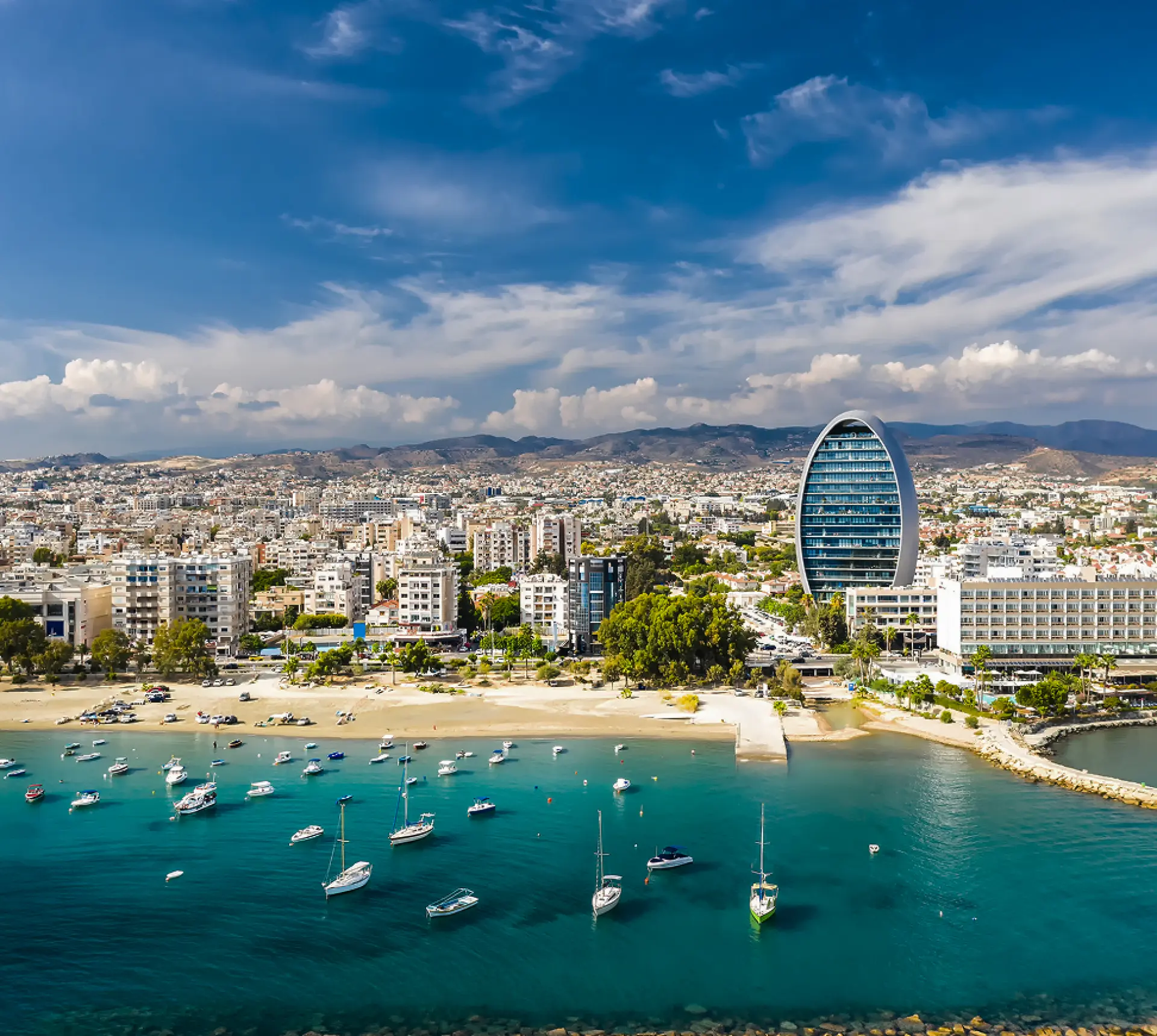
Limassol is often described as the best city to live in Cyprus — but is it really worth the high prices, heavy traffic and summer heat? Discover what life in Limassol is actually like, which neighbourhoods are worth considering and whether the city is the right choice for you.
If you ask foreigners who have moved to Cyprus which city they consider the most modern and comfortable place to live, the answer you will hear most often is Limassol.
Over recent decades, the city has developed from a major port into the economic capital of the Republic of Cyprus. Today, it is home to international companies, modern residential developments, well-developed infrastructure, prestigious schools, private clinics and the country’s largest property market.
At the same time, Limassol is not merely a place to work. It is a city where business life is combined with the sea, seafront promenades, restaurants, sports facilities and a lively cultural programme. Many residents begin their day with a run along the coast, work for international companies and meet friends in the Old Town, at Limassol Marina or in one of the city’s many cafés in the evening.
This is why Limassol is often the first choice for people moving to Cyprus.
However, it is important to consider the city’s particular characteristics. Housing is more expensive here than anywhere else in the country, traffic congestion is common during rush hour, and summer temperatures frequently exceed +35°C. Before moving, it is therefore worth considering whether Limassol matches your lifestyle and expectations.
In this guide, we explain how Limassol differs from other cities in Cyprus, which neighbourhoods are worth considering, what everyday life is like and who the city is best suited to.
Location | Southern coast of Cyprus |
Atmosphere | International business and resort city |
Best suited to | Families, expats and entrepreneurs |
Property | The most active housing market in Cyprus |
Cost of living | Among the highest in the country |
Car | Recommended in most neighbourhoods |
Climate | Hot summers and mild winters |
Limassol is not a city that suits everyone. For some people, it is an ideal place to live; for others, it may feel too expensive or fast-paced. It all depends on your goals and lifestyle.
If high-quality schools, modern residential developments, good healthcare infrastructure and a wide range of children’s activities are important to you, Limassol is considered one of the best options in Cyprus.
Thanks to its international community and the widespread use of English, settling in is generally easier here than in the island’s smaller towns.
Limassol is the main business centre of the Republic of Cyprus. It is home to international companies, law firms, shipping organisations and technology start-ups.
Modern infrastructure, a large number of international companies and a pleasant climate have made the city one of the main centres of Cyprus’s IT industry.
Strong demand for housing and the continued development of new projects make Limassol one of the country’s most attractive property markets.
Limassol’s history stretches back several thousand years. The modern city lies between two ancient city-states, Amathus and Kourion, both of which were important centres of ancient Cyprus.
One of the best-known events in Limassol’s history was the arrival of King Richard I of England, Richard the Lionheart, during the Third Crusade. In 1191, he captured the island and married Berengaria of Navarre in Limassol, where she was also crowned Queen of England.
In the centuries that followed, the city came under the rule of the Lusignans, the Republic of Venice, the Ottoman Empire and Britain. Each period left its mark on the architecture, culture and appearance of modern Limassol.
After the Republic of Cyprus gained independence in 1960, the city continued to develop rapidly as a major port. The events of 1974 marked a turning point: Limassol became the country’s principal seaport and began its rapid transformation into the economic centre of Cyprus.
Today, Limassol is the largest business city in the Republic of Cyprus, where international companies, modern residential districts and tourist infrastructure sit alongside a historic centre that preserves the memory of the city’s long history.
Limassol is located on the southern coast of the Republic of Cyprus, on the Mediterranean Sea. The city lies roughly halfway between Paphos and Larnaca, making it a convenient base for travelling around the island.
Larnaca International Airport is approximately 65 kilometres away, while Paphos International Airport is around 60 kilometres away. Depending on traffic, the journey usually takes between 45 minutes and one hour.
Limassol stretches for more than 20 kilometres along the coast. The southern part of the city is made up of beaches, seafront promenades, residential districts and tourist facilities. The main residential areas lie further north, followed by hills and suburbs offering views over the city and the sea.
The A1 motorway runs through the northern part of Limassol. It is Cyprus’s main transport route and connects the city with Nicosia, Larnaca and Paphos.
The city’s administrative area includes several municipalities and communities that have gradually formed a single urban area. Nevertheless, each part of Limassol retains its own character, building density and level of infrastructure.
Although Limassol appears to be a single city on the map, its different parts vary considerably in practice.
Broadly speaking, the city can be divided into four main areas:
Historic centre — the Old Town, Limassol Marina and the business district near the seafront.
Eastern Limassol — Germasogeia and Agios Tychonas, which are popular with expats because of their proximity to the sea and modern development.
Northern neighbourhoods — Agios Athanasios, Mesa Geitonia and Agia Fyla. These areas are dominated by residential districts, schools and family-oriented infrastructure.
Western Limassol — Zakaki and the surrounding neighbourhoods, which are developing rapidly due to new residential projects, the City of Dreams Mediterranean casino resort and other modern infrastructure.
The location of a neighbourhood is often the main factor affecting property prices, transport links and everyday lifestyle.
Limassol has a Mediterranean climate characterised by long, hot summers and mild winters.
The swimming season usually begins in May and continues until October. Some residents and visitors continue swimming even in November because the sea remains warm.
In summer, daytime temperatures are usually between +30°C and +35°C, although they can rise further during heatwaves. Rainfall is extremely rare during this period.
Spring and autumn are generally considered the most comfortable seasons. Temperatures make it possible to spend most of the day outdoors, while the sea remains warm enough for swimming.
In winter, daytime temperatures are usually between +16°C and +20°C. Snow is virtually unheard of in the city, and most of the annual rainfall occurs during the winter months.
Anyone moving to Cyprus should be aware of one particular feature of local housing: despite the mild winter, some homes without modern insulation or central heating can feel cool and damp indoors. In summer, meanwhile, almost all modern flats and houses have air conditioning, which is a necessity rather than a luxury.
Limassol’s climate supports an active lifestyle for most of the year. The city is well suited to walking, outdoor sport and spending time by the sea throughout much of the year.
Limassol is often described as the most international city in Cyprus, and this becomes apparent almost immediately. Greek, English, Russian, Ukrainian, Armenian and many other languages can be heard in its streets, cafés, shops and offices. The large number of international companies and foreign residents gives the city an open and diverse character.
The pace of life is faster than in other Cypriot cities. During the working week, activity is concentrated around office districts and business centres. In the evenings, life moves to the seafront, restaurants, cafés and sports clubs. At weekends, residents spend time on the beaches, walk along Molos, visit mountain villages in the Troodos range or attend cultural events.
Nevertheless, Limassol is not a metropolis. Despite its rapid development, the city retains many characteristics associated with life in Cyprus: a more relaxed pace than major European capitals, easy access to nature and the ability to reach the sea within minutes from almost any neighbourhood.
One of Limassol’s main advantages is the ease with which most everyday needs can be met. Regardless of where you live, supermarkets, pharmacies, cafés, bakeries, sports clubs and other essential services are usually only a few minutes’ drive away.
Residents generally shop for groceries at large supermarkets, although small shops and bakeries operate in almost every neighbourhood. Fresh vegetables, fruit and local produce are also available at farmers’ markets and specialist shops.
Most shops, shopping centres, banks and government offices are located along the main roads and in the city centre. At the same time, many everyday errands, from visiting a pharmacy to going for coffee, can often be handled close to home.
Limassol is well suited to people with active lifestyles. Walking and cycle paths run along the coast, while the city offers modern gyms, tennis courts, swimming pools, water-sports schools and numerous sports clubs for both children and adults. Molos promenade and Dasoudi Park remain two of the most popular places for walking.
Another distinctive feature is the city’s international environment. English is widely spoken in shops, restaurants, clinics and service businesses, meaning that most foreign residents settle in quickly even without speaking Greek.
It is worth bearing in mind, however, that everyday life depends heavily on the neighbourhood you choose. Many facilities in central Limassol are within walking distance, while a car makes daily journeys significantly easier for residents of the northern areas and suburbs.
Buses remain the main form of public transport in Limassol. They connect the city’s principal neighbourhoods and also provide links to other cities in Cyprus.
Despite improvements to the bus network, many residents prefer to use a private car. This is particularly relevant for people living in northern neighbourhoods or suburbs, or those who regularly commute to different parts of the city.
In central and coastal areas, many everyday errands can be completed on foot, with shops, cafés, beaches, sports clubs and other amenities close by.
The A1 motorway remains the city’s main transport artery, connecting Limassol with Nicosia, Larnaca and Paphos.
Traffic on the main roads can become considerably heavier during rush hour, particularly in the morning and evening.
Limassol is not divided into neighbourhoods according to a single consistent system. Historically, the city expanded gradually by incorporating neighbouring municipalities and settlements, which is why different parts of the urban area vary significantly.
When choosing a home, it is important to consider not only the distance from the sea, but also transport links, access to schools, noise levels, the age of the buildings and local infrastructure.
Below is a general overview of some of the best-known neighbourhoods.
Best suited to: people who enjoy historic surroundings and city-centre living.
Atmosphere: the historic and tourist centre of the city.
Property types: historic houses, flats in older buildings, small residential developments and properties requiring renovation.
Advantages
historic architecture;
a wide range of restaurants and cafés;
close to Limassol Marina and Molos;
most places can be reached on foot.
Points to consider
limited parking;
more noise during the tourist season;
most housing is in older buildings.
Best suited to: people who want to live close to the sea and urban amenities.
Atmosphere: a lively central neighbourhood.
Property types: flats, apartments, modern residential developments and a limited number of new projects.
Advantages:
beaches within walking distance;
a wide range of cafés, shops and restaurants;
convenient for living without a car;
good transport connections.
Points to consider
dense development;
a limited number of new residential projects;
above-average property prices.
Best suited to: families, expats and people who want to live close to the sea.
Atmosphere: a modern residential area.
Property types: modern flats, residential developments, townhouses and villas.
Advantages
new residential developments;
well-developed infrastructure;
popular with international residents;
beaches nearby.
Points to consider
property prices are above average;
the coastal area is busier during summer.
Best suited to: people who work in the city.
Atmosphere: a central residential neighbourhood.
Property types: flats, apartment buildings, modern residential developments and commercial property.
Advantages
convenient location;
well-developed infrastructure;
good transport connections;
a wide choice of flats.
Points to consider
fewer green spaces;
rush-hour traffic congestion.
Best suited to: people who work in different parts of the city.
Atmosphere: a residential neighbourhood with well-developed infrastructure.
Property types: flats, townhouses, detached houses and small residential developments.
Advantages
central location;
convenient road connections;
schools;
shops.
Points to consider
dense development;
fewer areas for walking.
Best suited to: buyers of premium property.
Atmosphere: a modern luxury neighbourhood.
Property types: luxury apartments, penthouses, waterfront villas and premium investment property.
Advantages
yacht marina;
restaurants;
the sea;
a high standard of service.
Points to consider
one of the most expensive areas of the city.
Best suited to: investors and people looking for new developments.
Atmosphere: a rapidly developing neighbourhood.
Property types: new-build homes, modern flats, residential developments and townhouses.
Advantages
City of Dreams Mediterranean;
new residential developments;
retail infrastructure;
future growth potential.
Points to consider
parts of the neighbourhood are still undergoing extensive construction.
Best suited to: people looking for more affordable housing.
Atmosphere: a predominantly residential neighbourhood.
Property types: flats, detached houses, townhouses and mid-market new-build properties.
Advantages
lower prices than in coastal neighbourhoods;
good infrastructure;
convenient access to the motorway.
Points to consider
further from the sea;
a less tourist-oriented area.
Limassol has the largest residential property market in Cyprus. Almost every type of housing is available, including flats, penthouses, townhouses, detached houses, villas and new residential developments.
Apartment buildings and modern residential projects dominate the coastal areas, while detached houses and villas are more common in the northern neighbourhoods and suburbs.
In recent years, the number of energy-efficient new-build developments with underground parking, swimming pools, gyms and gated grounds has increased significantly. At the same time, the city retains a large stock of older properties, which can vary in layout, insulation and technical condition.
When choosing a property, it is important to consider not only its distance from the sea, but also transport links, the age of the building, its energy-efficiency rating, the availability of parking, building service charges and the area’s future development prospects.
Limassol remains the country’s most active property market, and demand for good-quality homes is traditionally high.
Limassol is considered the most expensive city in the Republic of Cyprus. Housing costs are generally higher here because of strong demand from local residents, expats and international companies.
However, overall spending depends heavily on the neighbourhood, type of property and lifestyle. Living in the city centre or near the sea is usually more expensive than living in the northern neighbourhoods or suburbs.
The main areas of expenditure include:
renting or buying a home;
service charges and utilities;
electricity and water;
internet and mobile services;
food;
transport;
education;
healthcare;
sport and leisure.
The cost of restaurants, entertainment and everyday services can also vary considerably, ranging from small family-run establishments to premium restaurants and beach clubs.
Limassol plays a key role in the economy of the Republic of Cyprus. A substantial share of the country’s international business is based here, along with Cyprus’s largest commercial port.
The main sectors of the economy include:
international business;
information technology;
finance and investment;
shipping and maritime transport;
legal and corporate services;
construction and property;
tourism and hospitality.
Many international companies operating in European and global markets have offices in Limassol. As a result, the city attracts professionals from many countries and is considered one of the most popular destinations for relocation to Cyprus.
English is widely used in the workplace. In many international companies, it is the main language of communication.
Limassol is considered one of the best cities in Cyprus for families with children because of its wide range of educational institutions.
The city offers:
state schools;
private schools;
international schools;
nurseries;
language schools;
educational centres.
State schools teach primarily in Greek, while many private and international schools use English and follow a British or international curriculum.
Limassol also has higher-education institutions, and the city and surrounding areas offer numerous clubs, sports activities and creative studios for children.
Because demand is high at popular international schools, families are advised to check the availability of places well in advance.
Residents of Limassol can use both the GeSY public healthcare system and private medical centres.
The city has:
general hospitals;
private clinics;
diagnostic centres;
dental clinics;
specialist medical practices;
24-hour pharmacies.
Staff at many private medical facilities speak English, and consultations in other languages are available at some clinics.
Thanks to the large number of healthcare facilities, residents can usually access a broad range of medical services without travelling to other parts of the country.
Despite its status as a business centre, Limassol remains one of the most interesting cities in Cyprus for leisure. You can spend the day at the beach, walk through the historic centre in the evening, and visit archaeological sites or one of the city’s many festivals at the weekend.
The city’s coastline extends for more than 20 kilometres. It includes both organised urban beaches with extensive facilities and quieter stretches of coastline.
Most beaches have dark volcanic sand or a mixture of sand and pebbles.
Molos is one of the city’s main areas for walking.
The modern promenade includes pedestrian paths, cycle routes, children’s playgrounds, seating areas, cafés and public art. It is one of the most popular places in the city for both residents and visitors.
Limassol’s historic centre retains the atmosphere of an old Cypriot town.
It is home to traditional streets, small shops, art galleries, cafés, restaurants and cultural venues.
The medieval castle is considered one of the city’s principal historic attractions.
Today, it houses the Cyprus Medieval Museum.
The modern marina combines a yacht harbour, residential developments, restaurants, shops and pedestrian areas.
It is one of the most recognisable symbols of modern Limassol.
The ruins of ancient Amathus and the Kourion archaeological site are located near the city. Visitors can see an ancient theatre, mosaics and the remains of historic buildings.
Limassol is known for its annual events.
The best known include:
Limassol Carnival;
the Wine Festival;
cultural festivals;
sporting competitions;
concerts by international performers.
By European standards, Limassol is generally considered a safe city for everyday life.
Most residential areas are suitable for walking during the day and evening. However, as in any sizeable city, ordinary precautions are recommended: keep an eye on personal belongings in crowded places and do not leave valuables in your car.
During summer, particular attention should be paid to high temperatures and strong sunlight. In hot weather, it is important to stay hydrated and use sun protection.
✅ well-developed infrastructure;
✅ an international community;
✅ a wide range of employment opportunities;
✅ high standards of service;
✅ a broad choice of modern residential developments;
✅ the sea and well-maintained walking areas;
✅ international schools;
✅ an active cultural scene throughout the year.
⚠️ the highest housing costs in Cyprus;
⚠️ very hot summers;
⚠️ possible traffic congestion during rush hour;
⚠️ a car is almost essential in northern neighbourhoods;
⚠️ older housing may be less energy-efficient than modern new-build developments.
When choosing a city in which to live, it is useful to consider not only access to the sea, but also your lifestyle, budget and reasons for moving.
Limassol suits people looking for an active urban environment, an international community and a wide range of career opportunities.
Paphos is often chosen by those who prefer a slower pace of life, closer proximity to nature and a more relaxed atmosphere.
Larnaca may appeal to people who want to live by the sea with more affordable housing and easy access to the country’s largest international airport.
Nicosia is Cyprus’s only inland city and the country’s administrative capital. It is better suited to people working in the public sector, education or businesses focused on the capital.
Each city has its own characteristics, and the right choice depends on your priorities.
Compared with other cities in Cyprus, Limassol is considered the most expensive, primarily because of housing costs.
Yes, particularly in central and coastal neighbourhoods. However, for residents of the suburbs and northern areas, having a car generally makes everyday life considerably easier.
Greek is the official language, but English is widely used in business, education, services and everyday communication.
Yes. Thanks to its wide range of schools, healthcare facilities and family infrastructure, the city is considered one of the most popular destinations for families relocating to Cyprus.
Spring and autumn are generally the most comfortable seasons for moving, as temperatures are milder than in summer.
Limassol suits people looking for an active urban environment, modern residential neighbourhoods, an international community and life by the sea. If well-developed infrastructure, career opportunities and a broad choice of property are important to you, the city remains one of the best places to consider when moving to Cyprus.

Already have a place in mind? Take the next step and explore homes available across Cyprus.
Browse apartments, houses and new developments, explore properties on the map and compare your favourites to find the right fit.
