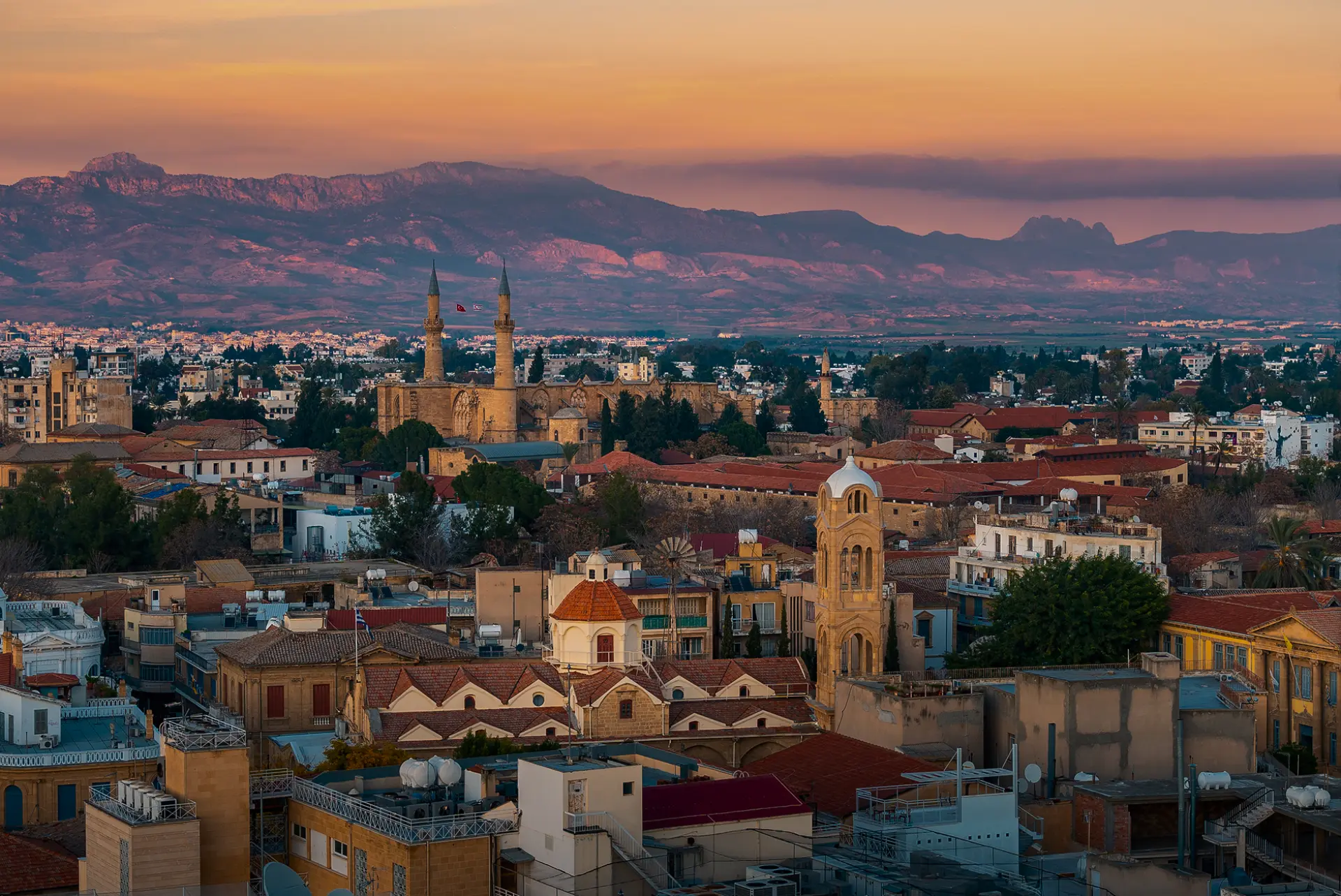
Nicosia, or Lefkosia, is a very different proposition from Cyprus’s coastal cities. It has no beach or marina, but it does have the island’s main concentration of government, finance, universities, professional services, healthcare, museums, and year-round urban life. It is also one of the places where the distinction between “city,” “municipality,” and “district” really matters. Since Cyprus’s 2024 local-government reform, the Municipality of Nicosia comprises the former municipalities of Nicosia, Aglantzia, Engomi, and Agios Dometios, while large parts of what everyone casually calls Nicosia, including Strovolos, Lakatamia, and Latsia-Geri, remain separate municipalities.
One important data note before we start: Cyprus’s 2021 census predates the 2024 municipal merger. It recorded 350,035 people in Nicosia District and 56,479 in the old Nicosia Municipality, but there is no single official 2021 census figure for today’s newly merged Municipality of Nicosia. I would therefore avoid publishing a supposedly precise “current city population” without explaining which boundary it refers to.
This page follows the same content architecture used on RERA’s Limassol area page, with Nicosia-specific adaptations where the geography genuinely calls for them. Most obviously, there is no beach or marina section to copy literally, so those slots are adapted to Nicosia’s parks, historic center, and civic public spaces.
Nicosia is the capital of the Republic of Cyprus and the island’s principal inland city. Unlike Limassol, Larnaca, and Paphos, it sits near the center of Cyprus rather than on the coast. The historic core is enclosed by the circular Venetian fortifications, while the modern city spreads far beyond them across the Mesaoria plain.
It is also a divided city. The historic urban area is intersected by the UN buffer zone, and the municipality itself describes Nicosia as Europe’s last divided capital. This guide focuses on the government-controlled southern part of the city and its surrounding urban suburbs, which is also the geography relevant to the RERA property market.
Administrative status: Capital of the Republic of Cyprus. Since the 2024 reform, the Municipality of Nicosia consists of the municipal districts of Nicosia, Aglantzia, Engomi, and Agios Dometios. Strovolos remains a separate municipality; Lakatamia and Latsia-Geri likewise belong to separate municipal structures.
Population: The 2021 census counted 350,035 residents in Nicosia District. The former, pre-reform Nicosia Municipality had 56,479. A comparable official population number for the post-2024 merged Municipality of Nicosia is not separately specified in the 2021 census, because that municipality did not yet exist.
Character: Administrative capital, university city, professional-services and business center, historic city, and large residential metropolis. Cyprus’s official tourism portal describes modern Nicosia as the epicenter of the island’s business and commercial activity, alongside its much older walled center.
Property market: Generally less expensive than Limassol, although prime new apartments in central locations and large houses in established suburbs can still be costly. A September 2026 listing analysis placed the median Nicosia apartment asking level at roughly €2,740 per m², while official Central Bank data showed Nicosia District’s residential property index up 5.7% year on year in Q2 2026. Asking prices and official valuation indices measure different things, so neither should be treated as a guaranteed transaction price.
Best known for: The Venetian walls, the old city, Ledra and Onasagorou streets, government institutions, universities, museums, galleries, Eleftheria Square, and a much more year-round rhythm than Cyprus’s resort areas.
Nicosia works especially well for families whose priorities are schools, universities, healthcare, office access, parks, and a normal year-round routine rather than being five minutes from the sea. Public and private secondary schools are regulated by the Ministry of Education, while the capital also has Cyprus’s largest concentration of university campuses and associated educational infrastructure.
Neighborhood choice matters more here than the word “Nicosia” on an address. A family working in central Nicosia but sending children to school in Strovolos or Engomi can have a very different daily commute from one living in the same district near both school and work. For that reason, I would choose the school and workplace first, then draw the housing search around them.
Strovolos, Engomi, Aglantzia, Lakatamia, and Latsia are the obvious areas to compare. The latest listing data show an unusually wide price spread: September 2026 median apartment asking prices ranged from about €205,600 in Lakatamia and €208,500 in Latsia to €320,000 in Strovolos and Aglantzia.
For expats who are moving to Cyprus for a professional position, university, regulated business, finance, public affairs, or a company with its office in the capital, Nicosia can be more practical than the coast. English is widely used in Cyprus’s international business environment, while institutions such as the University of Nicosia teach primarily in English.
The trade-off is straightforward: you get a proper working capital with less seasonal change, but you give up the ability to walk to the sea after work. For some people that is an immediate “no.” For others, especially anyone who treats the beach as a weekend activity rather than a daily requirement, it is barely a compromise.
Nicosia is a logical base for businesses that need regular access to ministries, regulators, lawyers, accountants, banks, universities, or government agencies. The Central Bank of Cyprus is headquartered on Kennedy Avenue in Nicosia, while Invest Cyprus itself operates from central Nicosia and promotes Cyprus particularly in financial services, technology, headquarters operations, funds, and other international business activities.
That does not mean every new international company is choosing Nicosia. Limassol remains exceptionally important for shipping and internationally oriented corporate activity. But Nicosia has a different strength: it puts the regulatory, administrative, education, finance, and professional-services ecosystem in one urban area. Cyprus’s ICT sector has also been one of the fastest-growing parts of the national economy, helping broaden the capital’s employment base beyond government and traditional professional services.
Nicosia makes sense for technology professionals who prefer a functioning city over a resort lifestyle, particularly when they need universities, research institutions, coworking environments, clients, or government contacts nearby. Cyprus has actively positioned itself as a technology and international-headquarters location, and Invest Cyprus reported in 2026 that €2.6 billion of 2024 investment had gone into ICT.
Remote workers who mainly care about sea views will probably still prefer Limassol, Larnaca, or Paphos. But people who want more apartment choice, universities nearby and, in many cases, lower housing entry prices than Limassol should not dismiss Nicosia simply because it is inland.
Nicosia is interesting because its housing demand is comparatively local. In Q2 2026, the Central Bank reported 1,076 sales contracts in Nicosia District: 901 involving local buyers, 90 EU foreign buyers, and 85 non-EU buyers. In other words, about 84% were local-buyer transactions in that quarter.
That gives the market a different risk profile from a location dominated by holiday homes or overseas demand. Universities create rental pockets around Engomi and Aglantzia, family housing is strong in Strovolos, and lower-entry-price owner-occupier stock remains available farther out in Latsia and Lakatamia. But there is no single “Nicosia yield.” Rental depth varies dramatically from one suburb to another. For example, a 2026 analysis found that only around 4% of Latsia listings were rentals, compared with 15% in Strovolos and 19% in Aglantzia.
Nicosia’s history is not something that sits in a museum and politely stays there. You feel it in the actual street pattern.
Settlement in the area goes back thousands of years. Visit Nicosia traces habitation in the fertile Mesaoria area to around the Chalcolithic era and identifies ancient Ledra as the predecessor of today’s city. Cyprus’s official tourism authority says Nicosia has served as the capital since the Late Byzantine period, around the 11th century.
The medieval city developed under the Lusignans and later the Venetians. The fortifications that define the Old Town today were reconstructed by the Venetians in the 16th century as a compact circular defense system with 11 heart-shaped bastions and a broad moat. The Ottomans later repaired the walls after taking the city.
British rule left another layer of civic and commercial architecture, while independence made Nicosia the administrative center of the modern Republic of Cyprus. Intercommunal conflict and the events of the 1960s and 1970s left the city divided, a condition still visible at the buffer zone and crossing points today. The Agios Dometios/Metehan crossing, for example, underwent an EU-funded expansion implemented by UNDP in 2026.
The simplest way to understand Nicosia is as a city that accumulated layers rather than replacing them. Medieval walls, Ottoman-era buildings, British civic architecture, 20th-century apartment blocks, polished new offices, pedestrianized shopping streets and university campuses are all part of the same urban story.
timeline
    title Nicosia historical highlights
    c. 3000 BC : Early settlement in the Mesaoria area
    Antiquity : Ledra develops on the site of modern Nicosia
    11th century : Nicosia established as Cyprus's capital
    16th century : Venetians build the circular walls and 11 bastions
    Ottoman period : City develops within and beyond the fortified core
    British period : New civic and commercial districts expand outside the walls
    Modern era : Nicosia becomes capital of the Republic of Cyprus
    1960s–1970s : Division reshapes the urban center
    2024 : Nicosia, Aglantzia, Engomi and Agios Dometios merge municipally
    2026 : Cross-city infrastructure and regeneration continue
The early-history and capital dates above follow the Deputy Ministry of Tourism and Visit Nicosia; the Venetian-wall description follows the official tourism authority, while the 2024 municipal change follows Cyprus’s post-reform electoral structure.
Nicosia sits inland, broadly in the center of Cyprus, on the Mesaoria plain. That one fact explains quite a lot about the city: there is no coastal humidity or immediate sea access, summer afternoons can feel fierce, and the city functions as a road hub connecting the island’s principal urban centers.
The historic center occupies the area inside the Venetian walls. Modern Nicosia then spreads south, east, and west into neighborhoods that have long since merged physically even when they remain administratively separate. That is why crossing from Nicosia Municipality into Strovolos often feels like crossing a street rather than entering another city. The administrative map and the lived urban map are not the same thing.
The city is also shaped by the buffer zone through its older center. The Ledra Street area provides the most visible pedestrian encounter with that geography, while Agios Dometios is important for vehicular movement across the divide.
For day-to-day property decisions, I would think of Nicosia geographically in four rings: the walled city, the modern central business/shopping area, the inner residential-university suburbs, and the outer family suburbs.
Nicosia is easier to understand when you stop trying to force everything into the official municipal boundary.
The Walled City is the historic core. This is where you find narrow streets, traditional buildings, museums, small restaurants, workshops, churches and mosques, Ledra Street, Onasagorou Street, Laiki Geitonia, and the most obvious physical evidence of the city’s long history.
The modern center outside the walls includes the Eleftheria Square/Makariou/Stasikratous area and the commercial streets extending south from the old city. The tourism board specifically identifies Makariou, Ledra, Onasagorou, Stasikratous, and Mnasiadou among the capital’s major shopping streets.
Engomi and Agios Dometios form the western inner-city belt. Engomi has a particularly strong university presence, including the University of Nicosia, as well as retail and established residential streets. Agios Dometios is closer to the buffer zone and remains a mixed, very urban residential district.
Aglantzia lies east and southeast of the core and is closely connected with the University of Cyprus and the wider Athalassa area. The University of Cyprus campus is at 1 Panepistimiou Avenue, Aglantzia, while other UCY facilities are also distributed through the area.
Strovolos stretches across a huge part of southern metropolitan Nicosia. It remains an independent municipality and is a major family, office, retail, and residential market in its own right.
Lakatamia and Latsia-Geri sit farther out and increasingly become the value end of the metropolitan housing market. They are not “central Nicosia,” but they are absolutely part of the daily commuter city. Their lower asking prices explain why many buyers expand their search outward once they compare what the same budget buys in Strovolos or Aglantzia.
Nicosia has Cyprus’s characteristic Mediterranean seasonal pattern, but its inland location makes the experience different from the coast. Summers are hot, dry, and sunny; winters are much milder than northern European winters but cooler than many people expect from holiday-Cyprus imagery. Cyprus’s national investment authority gives broad national averages of around 34°C in summer and 13°C in winter, although those figures should not be mistaken for precise Nicosia station normals.
For Nicosia specifically, the Department of Meteorology operates the Athalassa station network. Historic official reports underline just how hot inland extremes can become: Athalassa recorded 42.2°C during a June 2016 heat episode and 41.3°C during a September 2015 event. Those are extremes, not normal daily temperatures, but they are a useful reminder that insulation, air-conditioning efficiency, shading, orientation, and parking are genuine property features here.
There is no reason to invent a single “average Nicosia temperature” when the Department of Meteorology provides station and climatological data directly. For relocation decisions, the practical point is simpler: summer cooling matters more here than it does in many coastal apartments, especially on top floors with poor insulation.
Nicosia feels like a city where people actually have things to do on Tuesday morning.
That sounds obvious, but it is one of the clearest differences between the capital and resort-oriented parts of Cyprus. Ministries open, students go to lectures, offices fill up, cafes get busy before work, parents do school runs, lawyers disappear into meetings, and restaurants are not waiting for the tourist season to begin. Official tourism material describes the capital as both an ancient walled city and a fast-paced modern metropolis, with year-round retail, nightlife, museums, restaurants, and galleries.
The city is not uniformly hectic. A street inside the walls can feel almost village-like, while a major Strovolos avenue at rush hour is unmistakably metropolitan. Engomi around the universities has a younger rhythm; parts of Aglantzia feel greener and more residential; outer Latsia and Lakatamia are much more suburban.
For me, the easiest way to describe Nicosia’s appeal is this: it is not trying very hard to be a Mediterranean postcard. That is precisely why some people end up preferring it.
Daily life is neighborhood-dependent.
In the central area you can walk between offices, cafes, shops, cultural venues, and the old city. In outer neighborhoods, life becomes much more car-oriented. Public buses exist across the capital, but your experience changes enormously depending on whether your home, office, university, and school sit on a useful direct corridor. Cyprus Public Transport maintains current Nicosia route and timetable information, while the government’s Traffic4Cyprus platform publishes route, stop, timetable, and fare datasets.
Supermarkets, pharmacies, gyms, cafes, bakeries, restaurants, private clinics, schools, shopping centers and delivery services are spread throughout the urban area, so there is rarely a need to live in the center just to have basic amenities. What you do need to check is the micro-location: walking distance in August sun, actual morning traffic, parking availability, and whether “five minutes away” in an advert means five minutes at 11 p.m. or at 8 a.m.
A practical property-viewing trick is to visit a neighborhood twice, once during the evening and once during a weekday commute. Nicosia can change character dramatically by the hour.
Nicosia is Cyprus’s main inland road hub, but it does not have a railway or urban metro. Local public transport is bus-based. Cyprus Public Transport operates Nicosia’s city routes, and the official government transport-data platform provides network and timetable information.
Current fares changed in August 2026. A standard urban single trip is €2.70 when bought as a paper ticket from the driver and €2.00 using the relevant travel card, with separate night and pass pricing. Because fares and timetables change, I would check the operator rather than copy an old blog post before building a commuting budget.
Nicosia also has Pame Express Park & Ride services. Government transport datasets continue to list Park & Ride as part of the active public transport network, which makes it useful for commuters approaching the center by car.
Intercity Buses connect Nicosia with Limassol, Larnaca, Paphos and the Famagusta area. The operator’s 2026 timetable, for example, lists direct Nicosia-Limassol, Nicosia-Larnaca and Nicosia-Paphos services; the published Nicosia-Limassol journey is approximately 1 hour 45 minutes depending on service and conditions.
For flights, Larnaca International Airport is usually the practical first choice from Nicosia. Dedicated airport-shuttle services operate between the capital and Larnaca Airport; published timetable information indicates roughly a 40-minute scheduled journey from the Nicosia shuttle station in normal conditions, although I would always verify the live operator timetable before travel.
Nicosia’s transport choice is less about finding an exotic option and more about choosing a neighborhood that reduces how often you need to cross the city. Current city buses, Park & Ride and intercity services are documented by Cyprus Public Transport, Traffic4Cyprus and Intercity Buses.
There is one administrative caveat worth repeating: not every neighborhood below is inside the post-2024 Municipality of Nicosia. Strovolos, Lakatamia and Latsia are separate municipalities, but they are included because in real-life housing searches they form part of metropolitan Nicosia. Leaving them out would make the guide technically tidy and practically much less useful.
Best suited to: People who value walkability, historic architecture, culture, cafes, and a genuinely distinctive home over suburban convenience.
Atmosphere: This is the Nicosia that visitors remember. Venetian walls, narrow lanes, traditional buildings, small museums, workshops, bars, cafes, Ledra Street, Laiki Geitonia, churches, mosques and the physical presence of the divided city are all packed into a compact area.
Property types: Older apartments, restored traditional houses, mixed-use buildings, small investment units, and properties requiring significant renovation.
Advantages: Walkability, character, proximity to central employment and culture, scarcity of genuinely historic stock.
Points to consider: Parking, renovation quality, access, noise, building age and title/planning history deserve extra attention. I did not find a robust 2026 neighborhood-wide median based on a sufficiently transparent Old Town sample, so I would mark an “average Old Nicosia price” as unspecified rather than inventing one. For context only, current Nicosia-wide apartment asking data are around €2,740/m², but historic stock can sit far above or below that depending on condition.
Best suited to: Professionals who want to live near work, restaurants, shopping and the old city.
Atmosphere: More polished and contemporary than the Walled City, particularly around Makariou, Stasikratous and the Eleftheria Square corridor. Those streets form part of Nicosia’s main modern retail core.
Property types: Apartments dominate, ranging from older central blocks to renovated and newly developed units.
Advantages: Walkability, short central commutes, cafes and restaurants, access to cultural venues.
Points to consider: Parking and street noise vary enormously block by block. New or heavily renovated central stock can be priced at a substantial premium over older buildings, so citywide averages are especially unhelpful here.
Best suited to: Students, academics, medical professionals, expat families and buyers who want an established western suburb near universities.
Atmosphere: Residential but busy in the right places, with a clear university and student influence. The University of Nicosia is based here, and the district also has retail such as the Mall of Engomi.
Property types: Apartments, new student-oriented units, older family apartments, detached and semi-detached houses.
Advantages: Universities, healthcare, shopping, good access to western and central Nicosia.
Points to consider: University-adjacent properties can command a rental premium. September 2026 live-listing analysis put the median apartment asking price at about €285,000, with two-bedroom apartments around €300,000. A separate rental comparison put the two-bedroom median asking rent around €1,000 per month. These are listing medians, not achieved transaction or tenancy prices.
Best suited to: People who want an established, close-in urban neighborhood west of the center.
Atmosphere: Dense, practical and very much part of everyday Nicosia rather than a polished new-build suburb. It is one of the four municipal districts that now make up the enlarged Municipality of Nicosia.
Property types: Mostly apartments and established houses, with a mixture of older and newer construction.
Advantages: Short distance to central Nicosia and Engomi, established amenities, relatively central geography.
Points to consider: Some streets are affected by traffic and proximity to the crossing/buffer-zone infrastructure. The Agios Dometios/Metehan crossing underwent enlargement works in 2026.
A defensible current neighborhood-wide median was not specified in the sources I found, so I would compare any specific property against current same-street and same-building-age listings rather than attach a fake “average” to the whole district.
Best suited to: University staff and students, professionals, families and people who like proximity to the Athalassa side of the city.
Atmosphere: A mix of traditional neighborhood streets, apartment zones and university-oriented development. The main University of Cyprus campus is in Aglantzia.
Property types: Apartments are particularly important, including new two- and three-bedroom projects, plus family homes.
Advantages: University access, eastern-city employment links, relatively good access to major roads and green areas.
Points to consider: Demand around the university is not representative of every street. September 2026 data put the median apartment asking price around €320,000, with one-bedroom units around €158,500, two-bedrooms around €302,000, and three-bedrooms around €437,000.
Best suited to: Families, professionals, owner-occupiers who want larger apartments or houses, and anyone whose work or school is on the southern side of Nicosia.
Atmosphere: Large, established and varied. Strovolos is essentially a city within the city, with residential streets, office corridors, shops, schools and major roads. It remains its own municipality after the 2024 reform.
Property types: One of Nicosia’s broadest selections of apartments and houses, especially family-sized three-bedroom apartments.
Advantages: Housing choice, schools, services, strong family demand and large established residential areas.
Points to consider: It is no longer the obvious budget choice. September 2026 listing data put the median flat at €320,000 and the median house at roughly €800,000, the highest house median in the comparison set. Two-bedroom apartment asking rents were around €1,300 per month and three-bedroom apartment rents around €1,475, based on the portal’s live rental sample.
Best suited to: Buyers looking for suburban space and a lower entry price while staying within the Nicosia commuter area.
Atmosphere: More suburban and car-oriented than central Nicosia.
Property types: Apartments, houses, newer residential development and family-oriented stock.
Advantages: Lower prices than the inner suburbs. September 2026 listing data put the median apartment asking price at about €205,605, with two-bedroom flats around €195,000.
Points to consider: Your car becomes more important, and commute time can matter more than distance on a map. A home that saves €80,000 on purchase price but adds two difficult cross-city school runs every day is not automatically the better-value home.
Best suited to: First-time buyers, families on a tighter purchase budget and people who work on the southern or southeastern side of the capital.
Atmosphere: Suburban, low-rise in many areas, residential and far less “city-center” in feel.
Property types: Two-bedroom apartments are particularly abundant, alongside family houses and plots. A detailed August 2026 analysis found 102 apartments for sale, 67 of them two-bedroom units.
Advantages: This is one of the clearest value plays inside the metropolitan area. The same 2026 analysis put the median apartment asking price at €208,500, with one-bedroom flats around €140,000, two-bedrooms around €200,000, and three-bedrooms around €248,000. About 84% of apartments in the sample were below €250,000.
Points to consider: The rental market is thin. Only four apartment rentals were in the sample used to calculate a median asking rent of roughly €830 per month, so that figure should be treated as an indication, not a reliable market average. Car dependence and rush-hour traffic are also meaningful considerations.
The table below uses median asking prices from live September 2026 listings, not Land Registry transaction prices. That distinction is important. A seller can ask anything; an index of asking prices is useful for comparing areas but is not a substitute for a valuation or completed-sales evidence.
Neighborhood | Character | Recent property benchmark | Transport links | Main pros | Main cons |
|---|---|---|---|---|---|
Walled City / Old Nicosia | Historic, walkable, cultural | Neighborhood median unspecified; Nicosia-wide apartment asking benchmark ≈ €2,740/m² | Walkable center, city buses, taxis | Character, culture, central location | Parking, older stock, renovation complexity |
Engomi | University-oriented, established, international | Median flat ≈ €285k; 2-bed ≈ €300k; 2-bed rent ≈ €1,000/mo | City buses, main western corridors | Universities, services, rental demand pockets | University premium in some streets |
Aglantzia | Residential, academic, greener eastern side | Median flat ≈ €320k; 2-bed ≈ €302k | City buses, UCY links, eastern arterials | UCY, access to green areas | Some segments relatively expensive |
Strovolos | Large family and business suburb | Median flat ≈ €320k; 2-bed rent ≈ €1,300/mo | Extensive road/bus network, Park & Ride access from south | Family stock, services, choice | Traffic, higher house prices |
Lakatamia | Outer suburban, value-oriented | Median flat ≈ €205.6k; 2-bed ≈ €195k | Bus routes, major roads, car-oriented | Lower purchase prices, space | Longer central commute |
Latsia | Affordable, family-oriented, southern suburb | Median flat ≈ €208.5k; 2-bed ≈ €200k | A1/eastern corridors, buses, car | Strong entry-level value | Thin rental market, car dependence |
Nicosia is not one property market.
There is a historic-center renovation market, a city-center apartment market, a student and university market, a family apartment market, a suburban house market, and an increasingly price-sensitive first-time-buyer market. Looking only at the “Nicosia average” hides most of what matters.
Official Central Bank data show that the Nicosia District Residential Property Price Index increased 5.7% year on year in Q2 2026. Within that, Nicosia house prices were up 4.4% and apartment prices 4.6% year on year.
There is a useful nuance here. RICS/KPMG’s Q2 2026 benchmark described Nicosia apartment and house values as essentially flat quarter on quarter, even while Central Bank data remained clearly positive year on year. That is not necessarily a contradiction. The datasets have different samples and methodologies, and it can simply indicate that annual growth remained positive while short-term momentum became more subdued.
The buyer mix is equally revealing. In Q2 2026 Nicosia registered 1,076 sale contracts, of which 901 involved local buyers. EU and non-EU foreign buyers represented 90 and 85 contracts respectively. That local-buyer dominance is one reason I would analyze Nicosia more as an employment, education and family-housing market than as an overseas second-home market.
For buyers working with listing data, current Nicosia apartment asking levels around €2,740/m² provide a useful top-level reference, but neighborhood medians are much more informative. A €200,000-ish budget still has meaningful options in Latsia and Lakatamia, while prime central new builds or larger Engomi/Aglantzia/Strovolos properties live in a very different price bracket.
A few things I would check especially carefully in Nicosia:
Parking. An apartment that looks cheap can become annoying very quickly if both adults need cars and there is one awkward uncovered space.
Energy performance. Inland summer heat makes insulation, glazing, shading and efficient air-conditioning financially meaningful, not decorative extras. Official meteorological records from Athalassa show that severe inland heat episodes can exceed 40°C.
Building age and common areas. Central Nicosia has plenty of older apartment blocks. Inspect lifts, roofs, pipes, façades, common-expense arrears and the management arrangement, not just the renovated kitchen.
Permit authority. Cyprus’s 2024 local-government reform also changed the institutional landscape for planning and building administration. Do not rely on an old article telling you which town hall handles a permit file.
Asking versus achieved price. The neighborhood figures in this guide are asking-price medians. They are excellent for understanding relative positioning, but they are not a promise about what a seller will accept.
There is no authoritative official “Nicosia monthly cost of living” number that neatly bundles rent, groceries, utilities, transportation and entertainment, so I would rather leave that headline figure unspecified than dress up a crowdsourced calculator as official data.
Housing is the variable that changes the picture most.
Recent listing samples show how wide the spread can be. A two-bedroom apartment had a median asking price around €195,000 in Lakatamia, €200,000 in Latsia, €300,000 in Engomi and Strovolos, and €302,000 in Aglantzia.
On the rental side, 2026 listing analysis found two-bedroom asking-rent medians around €1,000 in Engomi, €1,025 in Aglantzia, and €1,300 in Strovolos. Latsia’s cross-apartment median was roughly €830, but that came from only four rentals, far too small a sample to treat as a stable average.
Transport can be inexpensive if your route works by bus. As of August 2026, a standard urban trip is €2.00 on the relevant card or €2.70 as a paper ticket from the driver. A household that needs two cars obviously has a very different monthly budget.
Electricity deserves special attention because of cooling. Instead of comparing apartments only by rent, I would ask to see actual summer electricity bills where possible and check the energy certificate, glazing, air-conditioning age and roof exposure. The difference between two similarly priced apartments can easily be hidden in how they perform in July and August.
Private schooling is another large optional cost for expat families. Cyprus has both public and private secondary education, and Nicosia offers substantial choice, but fees vary by institution and year, so school costs should be researched separately before choosing a house.
Nicosia’s economic identity starts with being the capital.
The city hosts the central government ecosystem, the Central Bank of Cyprus and a large share of the country’s legal, accounting, financial, consulting and professional-services activity. The Central Bank’s headquarters are on Kennedy Avenue, while Invest Cyprus also operates from central Nicosia.
Cyprus as a whole has developed strong financial-services, technology, investment-funds and international-headquarters sectors. Invest Cyprus describes the country as a financial, shipping and technology hub and specifically highlights financial services, funds, electronic money institutions and international business as important parts of the investment proposition.
Technology matters increasingly. Invest Cyprus, citing CYSTAT data, described information and communication as Cyprus’s fastest-growing sector over the preceding decade and reported substantial expansion in its share of gross value added. Its 2026 annual meeting also reported €2.6 billion of 2024 investment directed to ICT.
Nicosia additionally benefits from sectors that do not disappear when tourism slows: universities, healthcare, retail, public administration, banking, insurance and professional services. That is one of the strongest arguments for the city from a residential-investment perspective. Demand is tied to a diversified year-round employment base rather than one seasonal industry. This is an inference from Nicosia’s institutional concentration and the local-heavy property-buyer data.
Education is one of Nicosia’s strongest practical advantages.
The University of Cyprus, Cyprus’s public university, has its main campus in Aglantzia, with additional university facilities elsewhere in the capital.
The University of Nicosia is based in Engomi and offers more than 100 on-campus and online programs across eight schools. The university describes itself as teaching primarily in English, which helps explain why the Engomi rental market has a noticeably international and student-oriented segment.
Nicosia also has private universities and colleges elsewhere in the metropolitan area, including European University Cyprus in Engomi, strengthening the western side’s education cluster.
At school level, Cyprus’s Ministry of Education oversees both public and private secondary schools. For relocating families, the key question is not simply “Are there international/private schools in Nicosia?” There are. The important question is where the chosen school is relative to the home and workplace.
I would honestly put school commute ahead of an extra bedroom when choosing between two Nicosia neighborhoods. Twenty minutes saved twice a day, five days a week, tends to feel more luxurious than an extra 10 square meters.
Nicosia is one of the strongest locations in Cyprus for access to specialist healthcare.
Nicosia General Hospital is a major public hospital serving both inpatient and outpatient demand. The State Health Services Organisation states that it serves more than 160,000 inpatient and outpatient patients annually, plus around 55,000 patients through its Accident and Emergency Department.
Public primary-care facilities are distributed around the urban area as well. Engomi Health Centre, for example, operates as part of the state health-service network.
There is also a substantial private medical sector across Nicosia. For a household deciding where to live, however, I would look beyond a generic statement such as “good healthcare nearby.” Check the distance to the specific specialist, clinic or hospital you expect to use, particularly if someone in the family needs regular treatment.
Latsia’s southern location is convenient for access toward Nicosia General Hospital even though the hospital itself is in Strovolos, a boundary detail that several older area descriptions have historically blurred.
Nicosia obviously cannot copy Limassol’s leisure section word for word. The “Beaches” position in the Limassol template is therefore adapted here to parks and green space, and the “Limassol Marina” position becomes Eleftheria Square and the modern center. That keeps the original article structure while reflecting what Nicosia actually offers.
Nicosia’s leisure landscape is inland. Parks, linear walking routes and the Athalassa side of the city matter much more than waterfront promenades.
For a resident, green space is not just a weekend attraction. It can meaningfully change the feel of Aglantzia, Latsia and eastern Strovolos compared with denser central neighborhoods. Latsia’s position next to the wider Athalassa green area is one reason it appeals to families even though it is farther from the center.
Eleftheria Square is the transition point between the old walled city and modern central Nicosia. The official old-city walking tour starts from the Old Town Hall at Eleftheria Square, making it a natural reference point for exploring the historic center on foot.
From there, Ledra and Onasagorou lead into the old city while Makariou and Stasikratous form part of the modern shopping and dining center.
The walled city is Nicosia’s essential attraction, but it is also a real neighborhood rather than an outdoor museum. Laiki Geitonia, small workshops, museums, cafes and historic religious buildings sit inside a cityscape that has developed continuously over centuries.
The Venetian walls are the city’s defining piece of urban architecture. Built in the 16th century, they form a circular defensive system with 11 heart-shaped bastions and an approximately 80-meter-wide moat. Parts of that former defensive space are now used for gardens, recreation and other urban functions.
If you want one place that explains why Nicosia looks the way it does, the Leventis Municipal Museum is a good starting point. Its collections take the story from ancient Nicosia through Byzantine, Frankish, Venetian, Ottoman, British and modern periods. The museum opened in 1989 and later received the European Museum of the Year Award.
This heading adapts the Limassol page’s “Archaeological Sites” slot because Nicosia’s cultural draw is broader than one archaeological zone. The city’s strength is the concentration of museums, galleries, religious monuments, historic streets and preserved architecture inside and around the walls. Cyprus’s tourism authority specifically promotes the capital for its museums, galleries and historic monuments, while the municipality and tourism board run guided old-city walking routes.
Culture is one of the areas where Nicosia quietly outperforms the stereotype people sometimes have of an inland administrative capital.
The city has museums, galleries, theaters, music, book events, temporary exhibitions and a substantial university-driven cultural scene. Official tourism material emphasizes the mix of historic monuments with contemporary galleries, entertainment and nightlife.
The Leventis Municipal Museum alone holds more than 10,000 objects related to the history and development of Nicosia and runs temporary exhibitions, lectures, tours and educational activities.
The broader metropolitan area contributes too. Strovolos, for example, hosts cultural and public events including the Nicosia Book Fest, whose 2026 edition was scheduled in Acropolis Park.
Nicosia’s cultural advantage is not that every night feels like a festival. It is that museums, talks, performances, galleries, university events, restaurants and historic spaces are part of the normal calendar all year.
I would be careful with sweeping phrases such as “Nicosia is extremely safe” because there is no simple, current official city-level safety score that responsibly reduces crime, road danger, property theft and personal safety to one number.
Cyprus Police publishes official crime statistics, including serious crime, property crime, domestic violence, drug offenses and other categories, but the easily accessible public tables are not equivalent to a neat, internationally comparable Nicosia city crime index.
For everyday living, normal urban precautions make sense: lock cars and homes, take sensible care of belongings in busy places, and inspect security and lighting when viewing ground-floor properties. Cyprus Police itself regularly advises residents to take precautions against property offenses when homes are unattended or when visiting crowded areas.
Road safety deserves just as much attention as crime. If you are moving with children, I would check the actual walking route to school, not merely the straight-line distance. A “700-meter walk” across multiple busy avenues is not the same thing as 700 meters through quiet residential streets.
And in summer, heat is a real safety consideration too. Nicosia’s inland station has recorded temperatures above 40°C during significant heat events, so midday walking, pets, older residents and poorly cooled apartments deserve practical planning.
It is a real year-round city. Government, professional services, universities, healthcare, shopping and culture create activity twelve months a year.
There is genuine neighborhood choice. Historic inner-city living, university districts, family suburbs and lower-cost outer neighborhoods all exist inside the same metropolitan market.
Housing entry prices can be much more approachable than people expect. In September 2026, median apartment asking prices in Latsia and Lakatamia were around €208,500 and €205,600 respectively.
The employment base is diverse. Public administration sits alongside finance, professional services, technology, retail, healthcare and education. Cyprus is also actively developing its technology and international-headquarters sectors.
Education is a major strength. The University of Cyprus and University of Nicosia anchor substantial academic clusters in Aglantzia and Engomi.
Healthcare access is strong. Nicosia General Hospital is one of the country’s major public healthcare institutions, alongside local health centers and private facilities.
The property market is less dependent on overseas buyers. Local buyers represented roughly 84% of Nicosia District contracts in Q2 2026.
There is no sea. This sounds almost comically obvious, but it should be the first question. If daily coastal life is central to why you want to live in Cyprus, Nicosia may never feel like the right compromise.
Summer heat is more intense inland. Cooling, insulation, shaded parking and apartment orientation deserve more weight than they might on the coast.
A car is still very useful. Bus coverage exists and Park & Ride has improved the options, but many suburban family routines remain significantly easier by car.
Rush-hour traffic can change the meaning of “near.” This is why I would test the commute before signing a lease or purchase contract.
Some central housing stock is old. That can be charming, or it can mean poor insulation, awkward parking, aging lifts and a long list of common-area expenses.
The administrative map is confusing. A property marketed as “Nicosia” may be in Nicosia Municipality, Strovolos, Lakatamia or Latsia-Geri. Since the 2024 reform, even old guides can be wrong about which local authority applies.
Choose Nicosia when work, universities, schools, government, finance, healthcare and year-round city life matter more than being beside the sea. The capital combines Cyprus’s administrative and business functions with its main university clusters and a residential market where local buyers remain dominant.
Choose Limassol when an international business environment and coastal urban lifestyle are both priorities, and you are prepared for a more expensive property market. RERA’s Limassol guide describes the city precisely through that combination of business, international residents and Mediterranean waterfront living.
Choose Larnaca when access to the international airport and coast matters more than having the scale of the capital. Nicosia has direct intercity connections to Larnaca and airport-shuttle links, which is why some Nicosia residents happily treat the coast as a short trip rather than a reason to relocate.
Choose Paphos when lifestyle, tourism, retirement or a slower coastal environment matters more than proximity to Cyprus’s government and professional-services center. Direct intercity services do link Nicosia and Paphos, with a published journey of roughly two hours.
From a property perspective, I would resist ranking those cities as simply “better” or “worse.” They solve different problems. Nicosia’s strongest case is for someone who wants Cyprus to function as a place to live and work first, with the coast available when they want it.
It depends heavily on the neighborhood and whether you need a car or private schooling.
Housing is generally much less extreme than the top of the Limassol market, but Nicosia is not uniformly cheap. September 2026 asking-price data ranged from median apartments around €205,600 in Lakatamia and €208,500 in Latsia to €320,000 in Strovolos and Aglantzia. Current Nicosia-wide apartment asking prices were around €2,740/m².
For renters, two-bedroom asking-rent medians in the available 2026 samples were roughly €1,000 in Engomi, €1,025 in Aglantzia and €1,300 in Strovolos. These are asking figures from live listings, not an official rent index.
Yes, in the right part of central Nicosia and with the right routine. Living near work, university or a direct bus corridor can make it perfectly realistic.
It becomes much harder in outer family suburbs, particularly when school runs, shopping, sports and two different workplaces are involved. Nicosia has an active city-bus network and Park & Ride, but the transport system remains bus-based rather than rail-based.
My practical rule would be: do not ask “Can I live in Nicosia without a car?” Ask “Can I live at this exact address without a car?”
Greek is the principal official language in the government-controlled part of the city, while English is widely used in business, higher education and many service environments. Invest Cyprus explicitly describes English as widely spoken, and the University of Nicosia teaches primarily in English.
Learning some Greek still makes everyday life easier and, perhaps more importantly, makes the city feel more like home.
Yes, particularly for families prioritizing schools, universities, healthcare, larger residential neighborhoods and year-round routines. The capital offers public and private education, major university campuses and Nicosia General Hospital, while suburbs such as Strovolos, Engomi, Aglantzia, Latsia and Lakatamia provide very different combinations of housing and price.
The biggest mistake is choosing the house first and the school later. In Nicosia, I would reverse that order.
Spring and autumn are the easiest seasons for getting to know the city on foot because they avoid the strongest summer heat. The more practical consideration for families, however, is the school calendar, while renters should also think about university-driven demand near Engomi and Aglantzia.
There is no official “best moving month.” What is clear from Department of Meteorology records is that inland summer heat can become severe, so a July or August move means testing air-conditioning before the boxes arrive, not afterward.
This question needs a boundary attached to it.
The official 2021 census counted 350,035 people in Nicosia District and 56,479 in the former Nicosia Municipality. Since 2024, Nicosia Municipality has been enlarged to include Nicosia, Aglantzia, Engomi and Agios Dometios. Because that merger occurred after the census, a directly comparable official “2021 population of today’s Nicosia Municipality” is not specified as a single census unit.
For a property or relocation article, I would keep that explanation rather than combine incompatible boundaries into one impressive-looking number.
Broadly, yes, especially for mainstream apartments and suburban family housing, but the gap depends on neighborhood and property type. Current Nicosia apartment asking data are around €2,740/m², while individual Nicosia suburbs still show median apartment prices near €200,000 at the entry end. Limassol’s market has a much stronger premium associated with the coast and internationally oriented demand.
A luxury new apartment in central Nicosia can still cost considerably more than an older property in another Cyprus city, so city averages should never replace like-for-like comparisons.
It can be, but I like it for different reasons than a resort market.
The Central Bank’s Q2 2026 data show continuing year-on-year residential price growth and a buyer base dominated by locals. That supports a thesis built around employment, education and household formation rather than holiday demand.
The weak point is that rental liquidity is not uniform. Engomi and Aglantzia benefit from university demand; Strovolos has a meaningful family rental market; Latsia is considerably more owner-occupier oriented. An investor should therefore model a specific unit, tenant group and street rather than use a generic “Nicosia yield.”
Nicosia is probably the Cyprus city that makes the least sense from a holiday brochure and the most sense once you start thinking about ordinary life.
It is inland. It gets very hot in summer. Traffic matters. You will not finish work and walk directly onto a Mediterranean beach.
But you get something else in return: the country’s capital, its administrative institutions, major universities, major healthcare, professional services, a growing technology ecosystem, a remarkable historic center, and residential neighborhoods that range from genuinely urban to thoroughly suburban. Official tourism sources describe exactly this duality, an ancient walled city sitting beside a modern commercial capital.
For property buyers, the most important thing is not to treat “Nicosia” as one price point. September 2026 asking data put median apartments at roughly €320,000 in Strovolos and Aglantzia, €285,000 in Engomi, €208,500 in Latsia and €205,600 in Lakatamia. Those are dramatically different markets inside one metropolitan area.
The official market data add another useful piece of context. Nicosia District residential prices were still 5.7% higher year on year in Q2 2026, while around 84% of sales contracts involved local buyers. In my view, that is the central fact to understand about Nicosia real estate: this is primarily a city where people buy because their life is here, not because they spent a good week here on holiday.
And that is probably Nicosia’s best sales pitch, even though it does not sound like one. It is not Cyprus’s beach city. It is Cyprus’s everyday city.

Already have a place in mind? Take the next step and explore homes available across Cyprus.
Browse apartments, houses and new developments, explore properties on the map and compare your favourites to find the right fit.
