See what Cyprus banks publish and check, how to apply for a mortgage and how to estimate your monthly payment with a worked example.
A mortgage in Cyprus is the legal charge that secures a home loan against the property. The bank assesses your income, debts, deposit, credit history and residency, as well as the property's legal position and its own valuation. The mortgage is registered at the District Lands Office. Use the formula and worked example below to estimate your monthly payment, or try a bank's mortgage calculator. Before you reserve a property, ask two or three banks how much they might lend you and on what terms.
It is for anyone buying a home in Cyprus with a bank loan, whether you already live here, are about to move or still live abroad. It covers what to prepare, the steps in order, and which questions go to the bank and which to your lawyer.
There is no single rule for every buyer. Whether a bank lends to you, how much and on what terms is the bank's own decision, and the answer can differ from one bank to the next.
What usually makes a difference:
Lending requirements and the amount you can borrow vary by bank, borrower and property. Ask each bank what deposit you would need, how much it might lend and over what term.
What the banks publish. Three banks state their main housing-loan conditions on their own pages:
| Bank and loan | Who can apply | Financing and term as published | Calculator |
|---|---|---|---|
| Bank of Cyprus, First Home Housing Loan | Individuals who are permanent residents of Cyprus and are buying or building their main home | Up to 80% of the value of the property; up to 35 years; maximum age at loan maturity 65 | Instalment and affordability calculators |
| Alpha Bank Cyprus, Alpha Residence | Permanent residents of Cyprus | Up to 80% of the purchase value for a first main residence and up to 70% for the second; up to 30 years including any grace period; age at maturity not over 65 | Monthly Loan Installments Calculator listed among the site's tools |
| Eurobank, Home Loan | Individuals, permanent residents of Cyprus, buying, building or renovating their primary residence | Up to 80% of the value of the main residence, with the remaining 20% paid in cash or financed with an additional mortgage on another property; at most 30 years, the useful life of the property or the borrower's 65th year of age, whichever comes first | Online calculator linked from the Home Loan page |
Checked on 23 November 2026. Terms change; ask the bank for a written offer.
All three banks publish a variable-rate option and an option that starts with a fixed rate for a first period before switching to a variable rate (at Eurobank, the introductory fixed rate is for loans with a maturity of more than ten years). Bank of Cyprus and Alpha Bank Cyprus also offer a rate fixed for the whole term (at Bank of Cyprus, only on a loan of exactly 25 years). All three products in the table are for permanent residents of Cyprus, so if you live abroad, ask each bank what it offers in your situation.
Buyers from outside the EU. The Ministry of Interior says citizens of non-EU countries need permission from the District Administration to acquire property in Cyprus. Ask your lawyer when to apply and how the permission fits into your purchase. The application is made on form COMM 145 under the Acquisition of Immovable Property (Aliens) Law, Chapter 109 (Ministry of Interior: Purchasing Property). The form is submitted to the District Administration of the district in which the property is located, together with all the necessary supporting documents. Permission covers limited types and numbers of property: a plot or land not divided into plots of up to 4,000 m² for building a home for owner occupation, or up to two units (two dwellings, or one dwelling and a shop of up to 100 m², or one dwelling and an office of up to 250 m²). This limit applies in total to couples. Ask your lawyer to check that the property qualifies before you commit. Our guide to buying property in Cyprus as a foreigner covers the wider purchase process.
Income in another currency. If you earn in US dollars, pounds sterling or any currency other than the euro, while the loan and the property costs are in euros, exchange-rate movements change the real cost of every monthly payment. A lower interest rate may not make up for that mismatch over the years.
Use this checklist to prepare your mortgage application:
Ask each bank early for its own list for your situation, and collect everything in one go.
A mortgage calculator gives you an indicative payment. To work out your own estimate, use the formula below in a spreadsheet or on your phone; the bank table above lists the banks' calculators.
For a loan repaid in equal monthly instalments, each payment covers that month's interest, and the rest pays off part of the loan. On a long loan like the example below, the early payments are mostly interest and the late ones mostly capital.
The standard formula for such a loan is:
M = P × r / (1 − (1 + r)^−n)
In plain words: divide the yearly rate by 12, then put that monthly rate, the loan and the number of months into the formula.
Take a loan of €200,000 over 25 years (300 monthly payments) at an example rate of 4% a year:
Now change one thing at a time:
| Same €200,000 loan | Monthly payment (about) |
|---|---|
| Example rate 3%, 25 years | €948.42 |
| Example rate 4%, 25 years | €1,055.67 |
| Example rate 5%, 25 years | €1,169.18 |
| Example rate 4%, 20 years | €1,211.96 |
In this example, going from 4% to 5% adds about €113.51 a month, and going from 3% to 4% adds about €107.25. A shorter term raises the monthly payment but cuts the total interest: over 20 years at 4% you pay about €90,871 in interest instead of about €116,702 over 25 years.
How the 4% example is paid off over time (euros, rounded; each year's payments add up to about €12,668):
| Year | Interest paid that year | Loan repaid that year | Loan left at the end of the year |
|---|---|---|---|
| 1 | 7,913 | 4,755 | 195,245 |
| 5 | 7,090 | 5,578 | 174,209 |
| 10 | 5,857 | 6,811 | 142,719 |
| 15 | 4,352 | 8,316 | 104,269 |
| 20 | 2,514 | 10,154 | 57,322 |
| 25 | 270 | 12,398 | 0 |
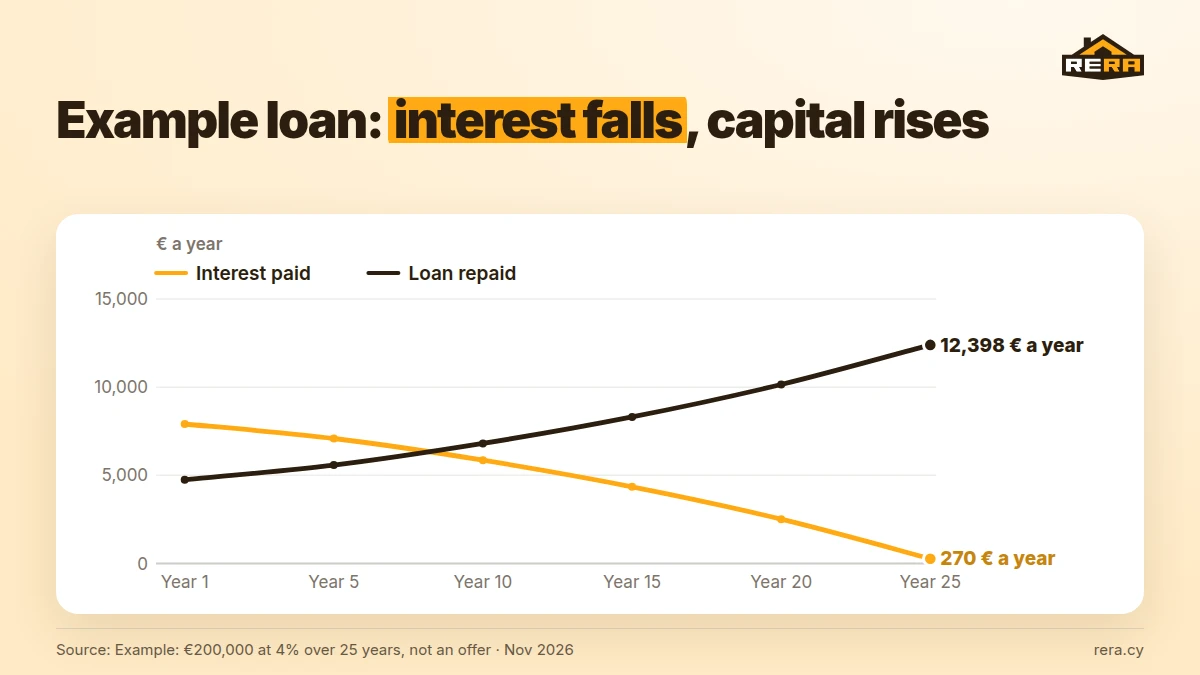
Chart: in the example loan, the interest share of each year's payments falls while the capital share rises
What the formula leaves out. It assumes the rate stays the same for the whole term. With a variable rate, your monthly payment can change as the rate moves, and the same applies once an introductory fixed period ends. The formula leaves out bank fees, required insurance, the mortgage registration fee and the costs of the purchase. Use a bank's calculator for an indicative estimate, and ask for a written offer to see the payment, fees and terms the bank would offer you.
The usual order is below. Your bank and your lawyer will tell you how each step applies to your purchase.
Ask two or three banks for a preliminary indication of how much they could lend you on a housing loan. Do this before you spend money on legal work, a valuation or a reservation. What can go wrong: reserving a property first and then finding the bank will lend less than you expected.
Hand in the documents from "Before you start". The bank reviews your income, existing debts, the source of your deposit, your credit profile and your residency status. What can go wrong: if a document is missing or the source of the deposit is unclear, expect questions from the bank before it decides, so answer them fully.
Two separate checks happen here. Your own independent lawyer checks the property: title deed status, planning and building permits, any outstanding charges on it, developer obligations for a new build, and the terms of the sale contract. Our guide to title deeds in Cyprus covers title deeds in more detail.
The bank values the property for its own purposes. A bank generally lends against its own valuation, not automatically against the price you agreed. If you agree to pay €350,000 and the bank values the property lower, you may need to put in more cash or renegotiate the price. What can go wrong: treating the advertised price as proof of the property's value.
Keep the two apart: the bank's valuation is for its lending decision, and it does not replace your lawyer's checks.
Get each offer in writing and compare more than the rate. Ask:
What can go wrong: choosing on the rate alone and missing the fees and conditions that come with it.
You sign the sale contract with the seller and the loan agreement with the bank. Before signing, ask your lawyer and the bank to confirm the order for your purchase: when you sign, when ownership transfers and when the mortgage is registered. Our guides to the buying process and the Land Registry in Cyprus cover the rest of the purchase.
The Land Registry's page on registering a mortgage defines a mortgage as a voluntary encumbrance of a property to secure payment of a liability. The owner who creates the mortgage is the mortgagor, and the person in whose favour it is created, here the bank, is the mortgagee.
The Land Registry's page lists these documents for the appointment:
The documents are submitted at the District Lands Office where you want the transaction processed. Once that office has checked that the documents are valid and complete, it tells you the date and time of the appointment by telephone or e-mail. Ask your bank and lawyer who prepares and submits these documents in your case.
For property in the non-occupied areas, the page states that 1% on the value of the mortgage is charged for registering it. There is also a charge for two Mortgage Registration Certificates, at €5.00 each.
If the property does not have its own title deed yet, your lawyer and the bank will explain how the loan is secured in that case.
Ask the bank what must happen before it releases the money and when your first repayment is due, and confirm this before you agree a payment date with the seller.
Costs that come with the loan. Budget for:
The questions in Step 4 cover the bank's side. The costs of the purchase itself, such as transfer fees or VAT, are explained in our guide to buying costs.
Interest rates. This guide does not quote rates. Check the bank pages above and ask each bank for a dated written quote for your loan.
Timing. Mortgage approval can affect the timing of your purchase, so ask the bank how long its decision usually takes. A seller may accept an offer that depends on your financing, but both of you need realistic dates and clear conditions in the contract.
If you are still deciding between a mortgage and cash. Paying cash avoids interest and means you do not depend on a lender approving you and the property, but it puts more of your money into one asset. A loan lets you keep a reserve for moving, furnishing, renovation or business, but it adds interest, lender conditions and the risk that the monthly payment changes if the rate is not fixed for the whole term. Whichever you choose, the legal checks on the property are the same.
When you have a budget in mind, search properties for sale in Cyprus on Rera, a property marketplace, and compare similar homes before you talk to the bank about a specific one.
Sources checked on 23 November 2026.

Planning to buy an apartment in Cyprus or looking for a rental property?
On RERA, you'll find 65,000+ up-to-date real estate listings across Cyprus – from studios and apartments to villas and commercial properties.