Compare asking rents by district, check an agent's licence and read the lease before you pay. See what the 2026 stamp duty repeal means.
When renting in Cyprus, expect rents to vary by district and home size. In rera.cy listings on 23 November 2026, the median asking rent for a 2-bedroom flat ranged from €1,100 a month in Nicosia district to €2,400 in Limassol district. Find your district and home size in the tables below, then open long-term rentals on rera.cy and compare homes like the one you want.
Search the listings, view the home and check who you are dealing with, read the lease, then sign, pay and move in.
This guide is for anyone looking for a long-term home to rent in Cyprus, whether you are moving from abroad or changing home on the island. You will get current asking rents by district and home size, checklists for the viewing and the lease, a simple check on the agent, and plain answers on stamping and registering a lease.
Holiday lets are not covered. If you are thinking about buying instead, start with our guide to buying property in Cyprus as a foreigner.
The tables compare monthly asking rents by district and home size, which tells you more than a single average rent in Cyprus would. An asking rent is the price the advertiser lists, which may change before you sign. Each cell gives the median (the middle value when rents are sorted), the range covering the middle half of listings and the number of listings.
Flats
| District | 1 bedroom | 2 bedrooms | 3 bedrooms |
|---|---|---|---|
| Limassol | €1,800 (1,500–2,240), 78 | €2,400 (1,900–3,500), 364 | €2,850 (2,100–5,000), 284 |
| Nicosia | €780 (670–950), 139 | €1,100 (850–1,500), 371 | €1,500 (1,150–2,100), 384 |
| Larnaca | €900 (760–1,100), 78 | €1,300 (1,000–1,500), 240 | €1,600 (1,290–2,020), 48 |
| Paphos | — | €1,800 (1,400–2,500), 37 | €2,300 (1,600–2,620), 11 |
| Famagusta | — | €1,380 (870–4,120), 14 | — |
Studios: only Nicosia district had at least 10 listings (13), with a median asking rent of €610 (590–630).
Houses
| District | 3 bedrooms | 4+ bedrooms |
|---|---|---|
| Limassol | €3,000 (2,200–4,500), 107 | €5,500 (4,000–9,500), 185 |
| Nicosia | €1,520 (1,200–2,060), 104 | €2,850 (2,000–3,900), 180 |
| Larnaca | €2,300 (1,520–2,950), 55 | €3,050 (2,500–5,000), 78 |
| Paphos | €3,500 (3,000–4,900), 47 | €4,400 (3,300–6,380), 34 |
| Famagusta | €2,500 (2,000–3,500), 21 | — |
Source: rera.cy listings on 23 November 2026. The snapshot has 3,112 long-term residential listings after cleaning (listings without a rental-period tag are counted as long-term; those marked short-term are excluded). The tables show selected home sizes; a dash means fewer than 10 listings. Flats include apartments, penthouses, maisonettes and duplexes; houses include detached and semi-detached houses, townhouses and villas.
Famagusta district has few listings (14 two-bedroom flats), so treat its range with caution.
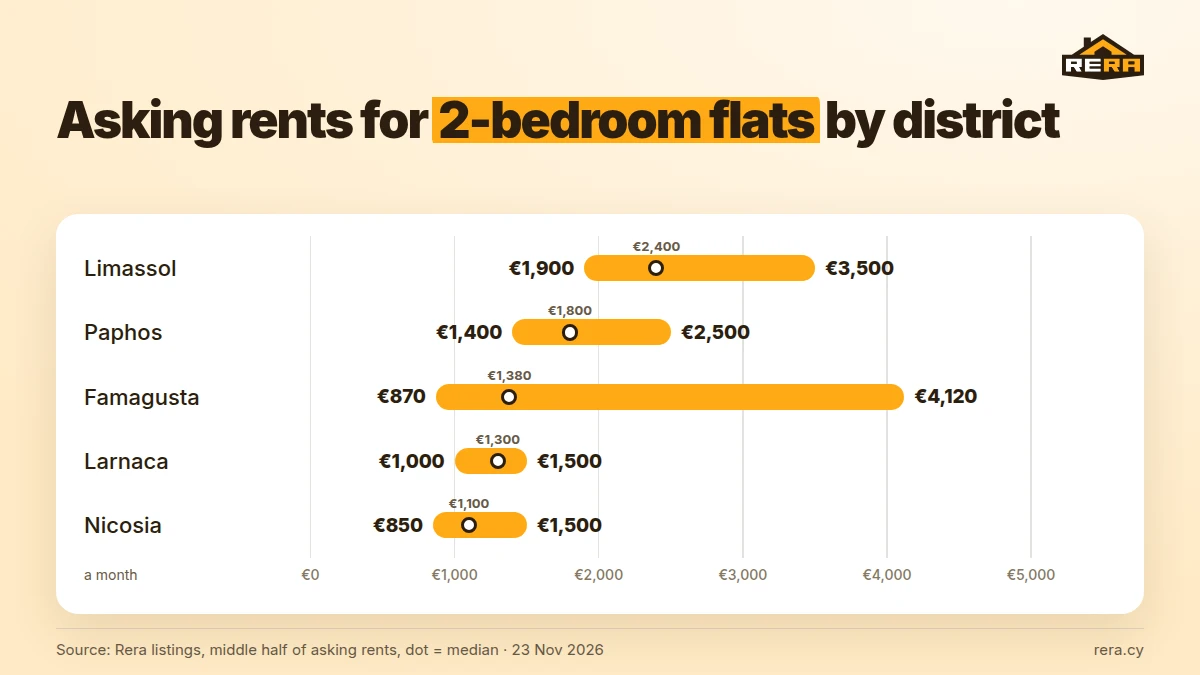
Chart of asking rents for 2-bedroom flats by district in Cyprus, November 2026
Even within one district, asking rents for the same home size vary widely (the middle half of 2-bedroom flats in Limassol district runs from €1,900 to €3,500), so compare homes with similar features when you browse the live listings.
To work out how much rent you can afford each month, bills and running costs included, see our guide to rental affordability in Cyprus.
Check that the home is offered for the period you need. Some listings are for holidays or short stays only. If a listing does not say clearly that it is a long-term rental, ask before you arrange a viewing.
Have your documents ready. Landlords and agents may ask for some of these:
What is asked for varies from one landlord to another, so treat this as a list to prepare, not a fixed requirement.
Decide what you will not compromise on. Write down your district, number of bedrooms, furnished or unfurnished, parking and pets. Filtering is much faster with that list in hand.
Start with long-term rentals, then check all residential rentals for homes without a rental-period tag. Confirm the rental period with the advertiser before booking a viewing. You can filter by city, price, property type, bedrooms and floor area, and narrow the search to flats or houses. To explore an area, use the map search.
Wherever you find the listing, view the home and check who you are dealing with, and pay nothing until both sides have signed the lease.
At the viewing, look past the photos. Check:
If an agent is involved, check the agent. In Cyprus, a person who wants to practise as a real estate agent must be on the Register of Real Estate Agents and hold a licence from the Council of Real Estate Agents. Leasing a property for a period of more than one month counts as a real estate transaction under the same rules, so this applies to long-term rentals too. A registered and licensed agent must show the phrase "registered and licensed real estate agent", with the registration number and the annual licence number, in every document or advertisement used in the profession. The rules are set out on the government's Business in Cyprus page for real estate agents.
Ask the agent for their registration number and annual licence number. If you are unsure, contact the Real Estate Agents Registration Council. A number may appear next to the agency name on a Rera listing.
If the advertiser says they are the owner, ask how they can show it, for example with a document in their name for the property. If someone else will sign for the owner, ask what gives them the authority to do so.
When leasing in Cyprus, the written lease is the document you will rely on. Ask for the full text before you pay a deposit or any reservation amount, and read it while there is still time to ask for changes. Check that it states:
Spoken promises, such as "leaving early will be fine", are not enough. If something matters to you, it belongs in the lease.
Ask the landlord, or a lawyer, which rules apply to the home you want. Our article on Cyprus tenancy rules goes into the lease clauses in more detail.
Do you need to stamp the lease? If the lease was drawn up and signed by at least one party by 31 December 2025, the old stamp duty rules and procedures still apply to it. A lease that no party signed before 1 January 2026 is not subject to stamp duty, because the Stamp Duty Laws were repealed from that date. You can read the Tax Department announcement on gov.cy (in Greek).
Do you need to register the lease? The Department of Lands and Surveys (the Land Registry) says that a lease of immovable property for a period greater than 15 years may be registered with it. Its page on registering a lease describes registration only for those longer leases, so it does not cover a lease for one or two years.
On the day you get the keys, make a move-in record:
Then the bills. Ask the landlord whether the electricity, water and internet accounts will move into your name or stay in the owner's name, and how you will pay them. In a block of flats, ask who pays the building's common expenses and how much they are.
Before signing, ask what you will need to pay beyond the first month's rent, how much each charge is and when it is due:
What depends on the situation:
Browse long-term rentals and compare homes that match your list.
Sources checked on 23 November 2026.

Planning to buy an apartment in Cyprus or looking for a rental property?
On RERA, you'll find 65,000+ up-to-date real estate listings across Cyprus – from studios and apartments to villas and commercial properties.