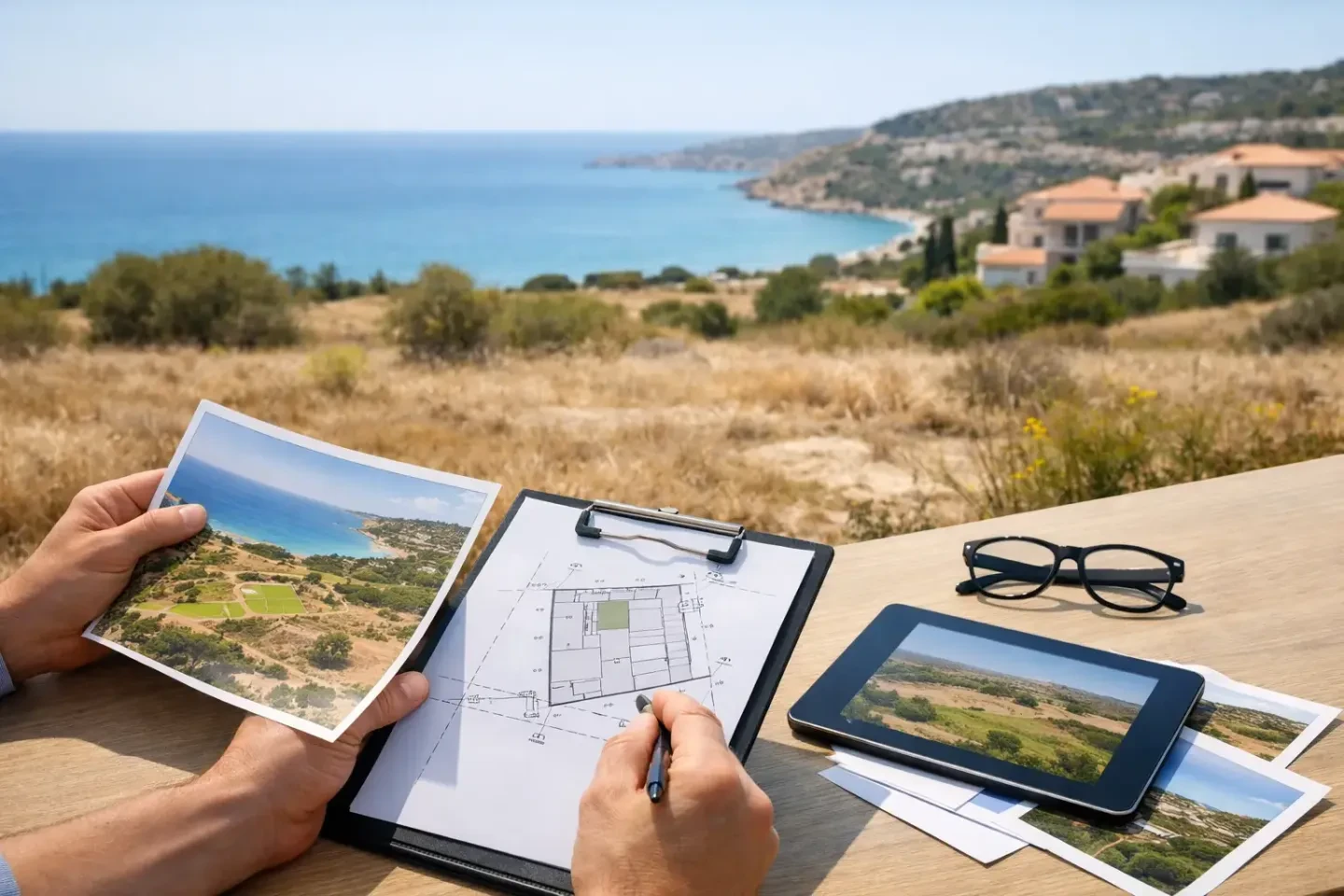
Learn how to buy land Cyprus with practical steps for ownership checks, zoning, permits, costs, and choosing a parcel for your plans without costly mistakes.
A low price per square meter can make a Cyprus land listing look compelling. But land is not a standardized product. Two neighboring parcels can have completely different building rights, road access, ownership history, utility costs, and resale potential. That is why learning how to buy land in Cyprus starts with due diligence, not an offer.
The right parcel depends on what you plan to do with it. A family building plot near a city, an agricultural field, a coastal development site, and land held for long-term investment should be assessed differently. The most useful question is not simply, "Is this land cheap?" It is, "Can this specific parcel support my intended use at a realistic total cost?"
Before searching, define the non-negotiables: your intended use, target area, total budget, desired plot size, and timeline. Include the cost of preparing the site, not just the purchase price. A parcel that needs retaining walls, a long utility connection, or a new access arrangement may cost less upfront but more by the time construction begins.
Think in terms of four categories. Is the land a residential plot, commercial site, agricultural field, or a larger development opportunity? Is it inside a designated planning zone? Does it have registered road access? And do you need to build soon, or are you comfortable holding land while plans develop?
Search results should be compared on more than size and asking price. Structured listing data can help you filter by district, land type, plot area, and price, while comparable listings help put an asking price in context. On RERA, use those details to create a shortlist, then treat every listing as a starting point for verification rather than a final answer.
A parcel may be marketed as "buildable," but that word alone is not enough. Ask for the planning zone and confirm it with the relevant authorities and your independent professionals. The zoning designation influences permitted use, building density, coverage ratio, number of floors, and maximum height.
For example, a residential plot may allow a home of a certain size, while a field outside a development zone may have very limited building rights. Agricultural land can be suitable for farming, a long-term hold, or a use that meets specific rules, but it is not automatically a site for a villa. Do not assume that nearby homes prove the same rights apply to the parcel you are considering.
Also ask whether the plot is affected by a local plan, road-widening proposal, protected landscape restrictions, coastal controls, archaeology, forest designation, or other limitations. These issues do not always make land unsuitable. They can, however, change the design, approval timeline, buildable area, or value of the investment.
If you intend to develop, speak with an architect or planning professional before committing. They can review whether your rough concept is feasible under current rules. A seller's verbal assurance is not a substitute for a written, professional assessment.
Legal access and practical access are different checks. A dirt track that reaches a parcel may not be a registered public road, and an easement may be required to cross neighboring land. Without appropriate access, obtaining permits or financing can become more complicated.
Check the road frontage shown on cadastral plans, whether any access rights are registered, and who is responsible for maintaining the route. Visit after rain if possible. A steep or poorly drained approach can materially affect construction logistics and future usability.
Then investigate utilities. Confirm the likely connection points and costs for electricity, water, telecommunications, and sewerage. In rural areas, a septic system, water storage, drilling, or substantial connection work may be needed. Request estimates where possible. "Services nearby" is not the same as services connected to the boundary.
Ownership checks are central when buying land in Cyprus. A lawyer acting only for you should review the title deed, cadastral information, seller identity, registered encumbrances, mortgages, memos, easements, leases, and any restrictions affecting transfer.
Ask whether separate title deeds are available. Where a separate deed exists, the transfer process is usually clearer, though the land still requires full checks. Where title is pending, the risks and contract structure need closer attention. You need to understand exactly what is being sold, what documentation exists, and the process for obtaining or transferring ownership.
Surveying also matters. Fences, walls, trees, or paths do not always match legal boundaries. For a plot with an irregular shape, a large site, or visible boundary uncertainty, engage a licensed surveyor. The usable area may be less than the advertised area once setbacks, slopes, access strips, and protected features are considered.
Be especially cautious with jointly owned land. A seller may own a share in a larger parcel rather than a specific, independently transferable section. That can be very different from buying a registered plot. Your lawyer should explain the ownership structure and whether a future division is legally and practically achievable.
Do not rush into a reservation payment just because another buyer may be interested. If a reservation is appropriate, the written terms should state the amount, how long the property is held, when it is refundable, and what due diligence must be completed before you are committed.
The sale contract should accurately identify the land and protect you if key conditions are not met. Depending on the transaction, these may include satisfactory title and legal searches, confirmation of planning parameters, mortgage release arrangements, access verification, and any required consent for a foreign buyer.
In the Republic of Cyprus, acquisition rules can differ based on nationality, residency, property type, and the buyer's legal structure. Non-EU buyers may need approval to acquire immovable property, and the details should be reviewed early rather than after contracts are signed. Corporate purchases can introduce separate considerations.
Use an independent Cyprus lawyer with land transaction experience. The seller, agent, developer, and lender may all be helpful sources of information, but their interests are not identical to yours. A buyer's lawyer should explain documents, risks, deposits, and filing requirements in plain language.
Your total budget may include legal fees, surveyor and architect costs, stamp duty, registration or transfer charges where applicable, VAT in some cases, permit fees, financing expenses, and currency conversion costs for international buyers. Tax treatment can vary according to the land, seller, transaction structure, and whether VAT applies.
Then add the site-specific costs that often change the decision: excavation, drainage, retaining walls, utility connections, road improvements, geotechnical investigations, and design work. Sloping land with sea views can be attractive, but it may require a more complex foundation, more engineering, and a longer build program than a flat urban plot.
If financing is involved, speak with lenders early. Land financing can have different loan-to-value limits, documentation requirements, and valuation standards than a completed home. Do not assume that a lender will value the site at the agreed purchase price or that future construction funding will follow automatically.
The best location depends on the end use. Land near Limassol may have a deeper buyer pool and higher price point, while areas around Larnaca, Paphos, Nicosia, or selected coastal communities may suit different budgets and demand patterns. A parcel near schools and year-round services can make sense for a family home. A tourism-oriented location needs a realistic review of seasonality, competition, and operating costs.
For an investment purchase, consider who might buy from you later. Is the future buyer likely to be a local household, a developer, an overseas purchaser, or an agricultural operator? Liquidity can be lower for unusual plots, land with difficult access, and sites where permissions are uncertain. A discount may be justified, but only if it reflects the actual constraints.
Visit the area at different times of day. Check traffic, neighboring construction, noise, drainage patterns, views that could be obstructed, and proximity to power lines or commercial uses. Listing photos capture the parcel. A site visit reveals the surroundings.
Once you have identified a suitable parcel, move methodically: verify the legal position, confirm planning potential, price the site works, and negotiate a contract that reflects the findings. If a check produces an uncomfortable answer, walking away can be a sound decision, even after time and professional fees have been spent.
Land can create flexibility that completed property does not. It can also transfer more responsibility to the buyer. The strongest purchase is usually the one where the title, planning rules, access, site condition, and budget all point in the same direction - before the deposit becomes non-refundable.

Planning to buy an apartment in Cyprus or looking for a rental property?
On RERA, you'll find 65,000+ up-to-date real estate listings across Cyprus – from studios and apartments to villas and commercial properties.